Process Matching Strategy Between Flexo Printing Width and Substrate Tensile Deformation
This technical paper explores the coupling relationship between
flexo printing width and substrate tensile deformation under different tension parameters, explains full-width multi-color registration deviation mechanism, and provides standardized width calibration process for film, paper and board substrates.
Different flexo printing widths produce completely different tensile deformation effects on roll substrates during high-speed operation. Wider web substrates bear larger transverse tension gradient, resulting in inconsistent stretching degree between the middle web area and two edge areas. This transverse stretching difference leads to longitudinal and transverse registration errors across the full web width, which is more prominent in wide web flexo printing than narrow web equipment.
Transverse tension gradient distribution varies directly with printing width increase. Under fixed linear running speed, the transverse tension difference between web center and web edges rises by 12% when printing width increases every 200mm. Uneven tension distribution makes edge substrates stretch longer than central substrates, generating periodic multi-color register deviation that cannot be solved by conventional single-point register correction.
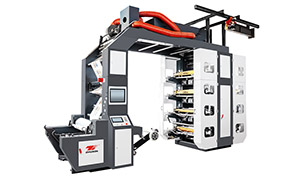
High Speed Flexo Printing Machine - Stack Flexo Flexo Printing Machine
Substrate types amplify the coupling effect between printing width and tensile deformation differently. Plastic film substrates including PE and PET have high ductility, and their full-width stretching difference is the most obvious, requiring segmented tension compensation for wide web printing. Paper substrates have low tensile elongation, so width-induced deformation is slight but easy to produce edge wrinkling under uneven tension. Thick paperboard substrates have almost no stretching deformation, and width matching mainly focuses on full-width pressure uniformity instead of tension adjustment.
Full-width online register detection system solves width-related registration defects fundamentally. Traditional single-point register cameras only detect central web patterns and cannot capture edge registration errors caused by width tension difference. The upgraded multi-point register system installs three groups of detection cameras at left edge, center and right edge respectively, realizing synchronous correction of full-width registration deviation adapting to different printing width sizes.
Regular width calibration cycle is essential for long-term stable flexo press operation. Mechanical wear of guide rollers and cylinder bearings will change transverse tension balance gradually after long-time operation. Technical teams need to conduct full-width tension calibration every 15 working days, test tension data of three web areas, and reset tension parameters to eliminate accumulated width deviation errors.
Reasonable width selection principle for actual production: narrow web presses are prioritized for label jobs with narrow fixed width to avoid excessive tension deviation; mid web presses are optimal for conventional flexible packaging with moderate width; wide web presses are only used for large-format bulk orders. Blindly selecting ultra-wide presses for small-width orders will increase tension control difficulty and raise defect rate greatly.