Pressure Adaptation and Rough Surface Ink Transfer Technology for Flexo Corrugated Printing
This deep technical article explains ink transfer mechanism on uneven corrugated board surface, analyzes pressure matching difficulties caused by board flute structure, and introduces flexible impression technology targeted for corrugated packaging printing.
Flexo corrugated printing is specially designed for uneven flute-type corrugated board, which is completely different from smooth substrate flexo printing. The concave-convex flute structure leads to inconsistent contact gap between printing plate and board surface, making uniform ink transfer the biggest technical challenge. Traditional fixed impression pressure suitable for film and paper will cause partial missing printing and excessive ink overflow on corrugated boards.
Three mainstream corrugated flute types including A flute, B flute and E flute have different surface unevenness, requiring differentiated printing pressure parameters. A flute has largest concave gap and needs the highest impression pressure; E flute has densest and flattest surface with pressure closest to common paper printing; B flute is the middle standard parameter configuration for general carton packaging.
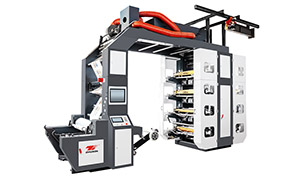
High Speed Flexo Printing Machine - Stack Flexo Flexo Printing Machine
Elastic cover impression roller technology solves uneven surface ink transfer defects. The surface of impression roller is covered with high-elastic thick rubber layer, which can fit the concave-convex board surface automatically during printing process. The elastic roller compensates the gap of flute structure dynamically, ensuring consistent contact pressure both on board peak and trough positions, realizing full and uniform ink transfer without missing dots.
Low dot gain printing plate matching for corrugated printing. Corrugated printing does not require ultra-fine gradient dots, so medium-hard photopolymer plates with Shore A 48 are adopted. Harder plates avoid excessive compression deformation under high printing pressure, keeping pattern edge sharpness. Soft plates will be overly squeezed into board concave positions, causing pattern blurring and ink spreading.
Anilox roller parameter exclusive design for corrugated printing. Compared with packaging flexo, corrugated printing needs larger ink transfer volume to cover rough board surface. 180LPI to 250LPI low-line large-volume anilox rollers are standard configuration, which can deliver enough ink layer to fill tiny board surface gaps and improve pattern coverage rate.
Common corrugated flexo printing defects and solutions. Partial missing printing is solved by increasing impression roller elasticity; pattern ink spreading is solved by raising plate hardness and reducing single-point pressure; board surface indentation is solved by adopting segmented pressure distribution to avoid local over-pressure damage to corrugated flute structure.