Precision Process Control and Dot Optimization for Narrow Web Flexo Label Printing
This technical article focuses on narrow-web flexo label printing core process parameters, analyzes fine dot reproduction difficulties for small-size labels, and provides targeted parameter matching schemes for food, cosmetic and pharmaceutical label mass production.
Narrow web flexo label printing is the most mainstream flexo application scenario, characterized by small repeat length, ultra-fine text and halftone dots, high requirement for multi-color registration accuracy and inline die-cutting synchronization. Different from wide-web packaging printing, label printing requires stricter pressure control, higher-precision servo register system and matched high-line anilox rollers to avoid tiny printing defects affecting label finished appearance.
The core technical difficulty of flexo label printing lies in controlling low-light dot gain below 10%. Most self-adhesive label substrates have smooth non-absorbent surface, leading to insufficient ink penetration and easier dot expansion under slight over-pressure. Even 0.03mm impression pressure deviation will cause blurred fine text and deformed 2% highlight dots, which are visible to naked eyes on finished small labels.
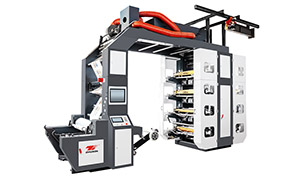
High Speed Flexo Printing Machine - Stack Flexo Flexo Printing Machine
Anilox roller line count grading matching standard for flexo label printing. Process color label patterns with gradient colors adopt 600LPI to 800LPI high-line anilox rollers for thin uniform ink layer and delicate dot restoration. Solid color background labels use 350LPI to 450LPI medium-line rollers to ensure high ink density without mottling. Spot color full-background labels match 250LPI to 300LPI low-line rollers to meet thick ink laydown demand efficiently.
UV ink exclusive process adaptation for self-adhesive label materials. Water-based ink will cause substrate edge curling and poor drying effect on waterproof plastic label materials, so UV instant curing ink becomes standard configuration for label flexo presses. Matching UV lamp power with printing speed is critical: each 50m/min speed increase requires 12% improvement of UV curing power to eliminate surface ink scratch and internal uncured hidden defects.
Inline die-cutting synchronization technology for one-stop label production. Flexo label presses integrate printing, laminating, slitting and die-cutting functions in one line. The servo system needs to keep printing cylinder and die-cutting cylinder phase synchronization within 0.01mm error. Asynchronous phase will lead to pattern offset relative to die-cut contour and waste massive finished label products.
Common label printing defects and targeted solutions. White edge defect is caused by insufficient plate edge pressure, solved by local plate padding; ink mottle on solid color is caused by mismatched anilox volume, solved by upgrading medium-volume anilox roller; longitudinal fine stripes come from doctor blade micro-vibration, solved by replacing composite damping doctor blades.