Narrow Web Flexo High-Resolution Printing: Anilox and Plate Optimization for Fine Screens
Narrow web flexo presses are widely used for producing high-quality labels and packaging that demand fine details, small fonts, and smooth vignettes. Achieving such resolution requires meticulous optimization of the anilox roller, printing plate, and press settings. This article provides a technical framework for high-resolution flexo printing on narrow web machines.
The fundamental requirement for high resolution is the ability to reproduce small dots (1-2% highlight dots) and maintain sharp edges without excessive dot gain. The anilox roller is the primary metering device; for fine screens, a high line screen anilox (800-1400 lpi) with a low cell volume (1.5-3.5 bcm) is essential. The high lpi ensures that individual cells are small enough to not be visible in the printed dot, while the low volume prevents flooding of the plate's recessed areas, which would cause dot bridging. The cell geometry – typically 60° hexagonal or oblique – influences ink release; oblique cells provide better release and are preferred for process printing.
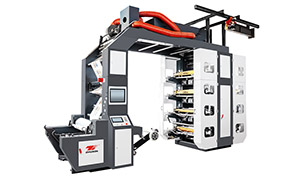
High Speed Flexo Printing Machine - Stack Flexo Flexo Printing Machine
Plate technology for fine screens: Flat-top dot (FTD) plates are mandatory for high-resolution because they maintain a stable dot surface area, reducing dot gain compared to round-top dots. The plate's relief depth should be shallow (0.2-0.3 mm) to minimize deformation under impression. A harder plate durometer (45-55 Shore A) is chosen to resist dot squash. The plate should be imaged using high-resolution LAMS (laser ablation mask) or direct laser engraving with a spot size of 10-20 µm to ensure fine details. Additionally, the plate screening should use a hybrid AM/FM approach – AM for the mid-tones, FM or stochastic for highlights to avoid the typical "grainy" look of flexo.
Press settings: Impression pressure must be minimized – often set to just 0.05-0.10 mm deflection – to avoid dot gain. The anilox-to-plate nip pressure is also critical; too high and it squeezes ink out of cells causing dot gain; too low and ink transfer is inconsistent. The doctor blade angle and pressure affect the ink film on the anilox surface; a sharper angle (e.g., 35°) with moderate pressure yields a cleaner wipe. The ink viscosity must be tightly controlled (e.g., within ±2 seconds on a Zahn cup) to maintain consistent transfer.
Substrate preparation: For films, corona treatment must be uniform and above 38 dynes/cm to ensure ink wetting. For paper, a smooth, coated surface is necessary; uncoated papers will cause dot spreading. The substrate's surface energy and absorbency directly affect dot shape – non-absorbent surfaces preserve dots, while absorbent surfaces cause dot growth.
Ink formulation for fine screens: The ink should have a fine particle size (≤1 µm) to avoid clogging the anilox cells and to provide smooth laydown. The pigment load must be optimized – too high increases viscosity and causes printing artifacts; too low reduces density. Adding flow agents can improve leveling and reduce mottle.
Quality assessment: Use a 10x-20x magnifier or a microscope to inspect the dot shape. Ideal dots should be round with sharp edges, no bridges, and uniform size across the plate. Measure dot gain using a densitometer with a G7 calibration. Target dot gain should be 10-15% at 50% tone for process printing. If gain exceeds 20%, reduce impression or switch to a lower volume anilox.
Case example: A premium wine label requiring 6-color process at 150 lpi was successfully produced on a
narrow web flexo press using a 1000 lpi anilox with 2.8 bcm, a 0.25 mm FTD plate, and impression of 0.07 mm. The dot gain was 13%, and highlights (2%) were perfectly reproduced. This quality rivaled offset, demonstrating that narrow web flexo can achieve outstanding resolution with careful optimization. Regular monitoring and plate/anilox maintenance are key to sustaining this level of performance.