Mid Web Flexo Press Versatility: Engineering for Film, Paper, and Board in One Line
Mid web flexo presses, typically covering print widths from 600 to 1200 mm, are the most versatile segment of flexographic equipment, capable of handling a wide range of substrates: thin films (12-50 µm), coated papers, paperboard, and even lightweight corrugated board. This versatility demands a press design that can quickly adapt its web path, tension settings, drying configuration, and impression pressure to suit each material. This article explores the engineering solutions that enable this flexibility.
The key to versatility is the modular design of the press. Mid web presses are often built in sections: an unwind module, a printing deck section with 6-10 colors, an optional coating/laminating module, and a rewind section. Each module can be individually controlled, and the web path can be configured with bypass rollers to skip unused dryers or chillers. The modularity also allows for future upgrades, such as adding UV LED curing or a digital hybrid unit, without redesigning the entire press.
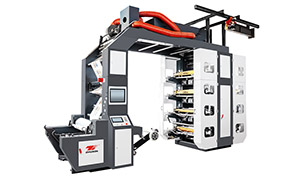
High Speed Flexo Printing Machine - Stack Flexo Flexo Printing Machine
Adjustable tension system: To accommodate substrates with vastly different elastic moduli (e.g., stretchable PE vs. stiff paper), the tension control system must have a wide range. Mid web presses use high-performance servo motors with torque control that can be set from 0.1 to 5 N/cm width. The dancer rollers have adjustable air pressure and stroke length, allowing fine-tuning of the tension profile. The system also stores tension recipes for each substrate type, so operators can recall them with a single command. The tension sensors are calibrated for low and high ranges, often using a switchable gain amplifier.
Impression and nip pressure adjustment: The printing decks are equipped with servo-driven impression mechanisms that can change the nip pressure in seconds. For soft films, the pressure is set low (0.05-0.1 mm deflection) to avoid stretching; for board, it is higher (0.2-0.4 mm). The anilox-to-plate nip also adjusts automatically, with a sensor that measures the contact force. Some presses feature a "pressure map" that shows the force distribution across the width, ensuring uniformity.
Drying and curing flexibility: A versatile mid web press may have multiple drying options: hot air for water-based inks, IR for added evaporation, and UV for curing. The dryers are arranged in a way that they can be selectively turned on or bypassed. For example, when printing with water-based ink on paper, only hot air is used; when printing UV on film, the hot air is turned off and UV lamps are active. The control system automatically sets the drying configuration based on the job recipe. Additionally, the drying tunnel length can be adjusted by changing the web path (e.g., using extra rollers to increase residence time for thick coatings).
Substrate handling and guiding: The web path includes several rollers with adjustable heights to accommodate different material thicknesses. The edge guides have wide detection ranges and can be switched between edge and center mode. For delicate films, the press includes low-inertia rollers with air bearings to minimize drag. Static elimination devices (ionizing bars) are placed at multiple points to prevent dust attraction and static discharge, which are more problematic for films.
Automation for quick changeover: Because the press runs multiple substrate types in a day, quick changeover is essential. Mid web presses often have automated plate sleeve and anilox sleeve change systems, along with wash-up units for ink chambers. The entire changeover sequence – from stopping the press to restarting with a new substrate – can be completed in under 15 minutes, including tension recipe loading and registration setup.
Maintenance for versatility: The increased number of adjustable components means more maintenance points. Regular calibration of tension sensors, checking of roller parallelism, and lubrication of all moving parts are critical. However, the modular design simplifies access. Many mid web presses have built-in diagnostics that alert operators when a component needs attention.
The
mid web flexo press exemplifies the "Swiss Army knife" of printing equipment, offering converters the capability to respond to diverse customer orders without investing in multiple specialized presses. With ongoing advancements in automation and sensor technology, these presses continue to expand their substrate range and quality levels, making them a cornerstone of the packaging industry.