Mid Web Flexo Press Color Management and Consistency Across Substrate Variations
One of the greatest challenges in mid web flexo printing is achieving consistent color reproduction when the same job is run on different substrates – for instance, printing a brand color on both a coated paper and a clear film. The substrate's surface energy, absorbency, and color (whiteness) profoundly affect the final color appearance. This article discusses the technical strategies for managing color consistency on versatile mid web flexo presses.
The fundamental issue is that the ink film thickness and its drying behavior change with the substrate. On absorbent paper, the ink penetrates the surface, reducing the effective optical density, while on non-absorbent film, the ink sits on top, yielding higher density for the same ink volume. The anilox volume must be adjusted to compensate: a higher volume for paper, lower for film. However, changing anilox is time-consuming; many mid web presses use a "dual-purpose" anilox with a moderate volume, and instead adjust the ink viscosity (thickener for paper, thinner for film) to modulate the transfer. This is done automatically by a viscosity controller.
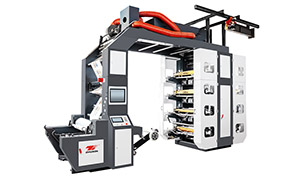
High Speed Flexo Printing Machine - Stack Flexo Flexo Printing Machine
Color measurement and control: Inline spectrophotometers placed after the drying/curing unit measure the L*a*b* values of control patches. The system compares them to the target values and calculates the delta E. If the delta exceeds a tolerance (e.g., 1.0), the controller adjusts the ink feed rate, anilox pressure, or dryer temperature. However, because different substrates have different background colors, the target values must be substrate-specific; the press stores a target profile for each substrate. The system also accounts for the substrate's opacity – for transparent films, a white ink layer may be printed first as a background, and its density is also controlled.
Ink formulation for multi-substrate: Many mid web converters use a "universal" ink system that works on both paper and film with minor adjustments (e.g., a specific additive). The ink manufacturer provides a compatibility chart. However, the best approach is to use substrate-specific inks for critical jobs; the press's job recipe includes the ink type and its viscosity setpoint. The ink pump system has multiple tanks, allowing fast changeover between inks.
Drying effects on color: The drying temperature and duration affect the final color. Over-drying can cause resin cross-linking (darkening) or pigment migration. The press's control system monitors the substrate temperature and adjusts dryer power to maintain a consistent drying curve for each substrate. This is especially important for water-based inks on paper, where the drying also affects the paper's moisture content, which influences color density.
Process control using G7 and other standards: Many
mid web flexo lines implement G7 calibration, which linearizes the print process to produce a neutral gray. The press's control system uses a dedicated gray balance control loop that adjusts the cyan, magenta, and yellow ink densities to maintain a target gray value. This ensures that color shifts are minimized even when substrate changes. The calibration data is stored per substrate and per plate set.
Operator involvement: Despite automation, operators still visually inspect prints and compare to a master sample. They are trained to detect subtle color shifts and can manually override the automatic corrections. The press also includes a "color adjustment" feature where the operator can nudge the density up or down for a specific color, and the system saves the offset for future runs on that substrate.
Data logging and traceability: Every color measurement is recorded with a timestamp, substrate ID, and job number. This data is used for statistical process control (SPC). If a color drift trend is detected, the maintenance team can check anilox wear or ink batch variations before it causes a reject. By combining advanced color measurement, substrate-specific profiles, and robust automation, mid web flexo presses achieve remarkable color consistency, enabling converters to deliver brand-color accuracy across diverse packaging materials with minimal waste and rework.