Micro-cell Structure Technology of Ceramic Anilox Roller and Ink Transfer Volume Calculation Model
This deep technical article focuses on micro-cell geometric structure of laser engraved ceramic anilox rollers, establishes accurate ink transfer mathematical model, and analyzes how cell opening ratio, depth and wall thickness affect actual ink delivery performance.
Modern flexo printing adopts full ceramic laser engraved anilox rollers as standard configuration, and micro-cell geometric parameters determine final ink transfer volume more critically than cell line count alone. The same line count anilox roller with different cell depth and opening ratio shows 20% to 30% difference in actual ink transfer volume, which is the core reason for inconsistent color density even with same roller specification selection.
Three core micro-cell geometric parameters affect ink transfer performance: cell depth, cell opening diameter and cell wall thickness. Deeper cells store more ink but increase residual ink volume after doctor blade scraping. Larger cell opening ratio improves ink release rate while increasing risk of dot expansion. Thicker cell walls reduce effective ink storage area and lower overall ink carrying capacity.
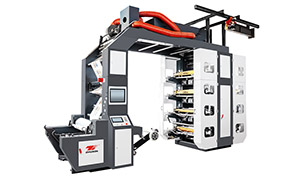
High Speed Flexo Printing Machine - Stack Flexo Flexo Printing Machine
Hexagonal honeycomb cell is the optimal structure for flexo
anilox rollers compared with square and triangular cells. Hexagonal cells have the highest space utilization rate with 12% more ink storage capacity than square cells under the same line count. Meanwhile, uniform hexagonal cell wall stress reduces cell wear speed by 25% during long-term friction with doctor blades, extending roller service life significantly.
The actual effective ink transfer rate of anilox roller is only 35% to 55% of nominal cell volume. Most ink stored in microcells remains inside cells after contact with printing plate due to ink surface tension. Higher ink viscosity leads to lower ink release rate, so solvent-based ink needs anilox roller with 10% larger nominal cell volume than water-based ink to achieve the same printing color density.
Laser engraving process parameters directly determine cell consistency of anilox rollers. Pulsed laser power, engraving speed and focal distance affect cell depth uniformity across full roller width. Unqualified engraving parameters cause inconsistent cell volume between roller middle and edge positions, resulting in full-width transverse color difference that cannot be solved by pressure adjustment.
Scientific cleaning cycle matching with cell structure prevents permanent cell blockage. Shallow and fine cells for high-line rollers are easier to be blocked by dried ink residue, requiring ultrasonic cleaning every 7 working days. Deep large cells for low-line rollers can maintain normal performance with cleaning every 14 working days. Targeted cleaning cycle protects micro-cell structure and stabilizes long-term ink transfer performance.