Mechanical and Electronic Repeat Length Calibration Principle for Servo Flexo Presses
This technical article explains the mechanical error source of traditional fixed repeat length, elaborates electronic stepless repeat length adjustment principle of full-servo flexo presses, and introduces high-precision repeat length calibration method to eliminate cumulative pattern cycle errors.
Flexo repeat length is physically determined by the effective outer circumference of plate cylinder including printing plate thickness and adhesive tape thickness, rather than the bare metal cylinder circumference. Most enterprises only calculate bare cylinder size during prepress layout design, ignoring the thickness superposition of photopolymer plate and mounting tape, which causes initial repeat length deviation and cumulative pattern dislocation after continuous rotation.
Traditional gear-driven flexo presses adopt fixed mechanical repeat length, and repeat length can only be changed by replacing plate cylinders with different circumferences. Each mechanical cylinder has inherent manufacturing tolerance within plus or minus 0.03mm. After 1000 cycles of cylinder rotation, the tiny single-cycle error accumulates into visible pattern splicing deviation exceeding 0.3mm, damaging continuous pattern integrity.
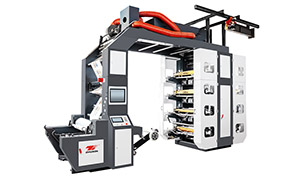
High Speed Flexo Printing Machine - Stack Flexo Flexo Printing Machine
Full-servo electronic repeat length adjustment realizes stepless cycle modification without replacing mechanical cylinders. Each plate cylinder is driven by independent servo motor, and the system changes the rotation angle ratio between plate cylinder and impression cylinder electronically to adjust virtual printing cycle length. The electronic adjustment accuracy reaches 0.001mm per cycle, far higher than mechanical cylinder replacement precision.
Substrate stretching compensation is a necessary secondary calibration for
flexo repeat length. Plastic film substrates produce permanent micro stretching under traction tension during high-speed printing, making actual printed repeat length longer than the set value. The repeat length compensation system monitors real-time web elongation data and automatically shortens electronic set repeat length to offset substrate stretching error dynamically.
Two common repeat length matching errors in prepress design: integer multiple mismatch and decimal point deviation. Pattern design length must be the exact integer multiple of press repeat length. If decimal deviation exists, continuous patterns will produce staggered splicing lines. Professional prepress workflow needs to unify design document repeat parameter and press calibrated repeat length before plate making.
Regular dynamic repeat length calibration is required to eliminate servo motor operation drift. Servo motors produce subtle angle drift after long-time continuous operation, changing actual printing cycle length. Technical personnel need to perform zero-point calibration for repeat length parameters every week, reset servo phase angle, and ensure long-term repeat length accuracy within plus or minus 0.01mm.