Inline Flexo Press Synchronization and Dynamics of Integrated Converting Units
An inline flexo press integrates multiple converting processes – such as die-cutting, lamination, slitting, and sheeting – into a single production line, all driven by a common web. The synchronization between the printing decks and these converting units is critical because any mismatch in speed or phase causes registration errors between the printed image and the cut, fold, or laminate. This article explores the engineering principles and control strategies for maintaining perfect synchronization in inline flexo lines.
The fundamental challenge is that printing decks require precise phase alignment among themselves (register), while the converting units must align to the printed pattern (cut-to-print registration). The web path length from the last printing deck to the die-cutting unit may be several meters, introducing a transport delay that varies with web tension and speed. The synchronization system must account for this delay and compensate for any web stretch or slip.
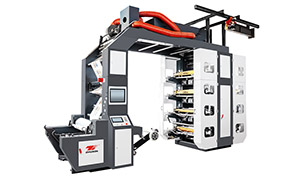
High Speed Flexo Printing Machine - Stack Flexo Flexo Printing Machine
Control architecture: Typically, the press has a master speed reference (often the central impression drum or the main drive roller). All printing decks and converting units are servo-driven and follow the master speed, but with independent phase offsets. The phase offsets are set based on the physical distance between units and the web's stretch factor. For die-cutting, a registration mark sensor reads the printed mark before the die, and a correction is applied to the die cylinder's rotational phase – this is a closed-loop cut-to-print control. Similar loops exist for lamination and slitting, though slitting only requires lateral alignment.
Dynamic coupling: When the press accelerates or decelerates, the web tension changes, causing the web to stretch or contract. This change affects the timing of the mark arrival at the converting unit. To counter, the control system uses a feedforward model that predicts the stretch based on speed and tension, and adjusts the phase offset preemptively. This is called "dynamic register compensation." The model must be calibrated for each substrate type, as different materials have different elastic moduli.
Mechanical considerations: The converting units impose additional drag on the web, which can cause tension disturbances upstream. For example, a rotary die-cutter has a periodic load as the cutting edges engage, causing a torque ripple that transmits back through the web. To isolate this, the line often includes a tension isolation dancer just before the converting unit. The dancer has its own motor that actively adjusts to maintain constant tension, decoupling the converting unit's dynamic behavior from the printing decks.
Web guiding across units: The web must maintain lateral position through all units. Inline lines incorporate multiple edge guides or center guides, especially before and after the printing section and before the slitting. The guides are interconnected so that a lateral shift in printing is compensated by a similar shift in the die-cutting, ensuring that the cut is always aligned to the print.
Integration with automation: Modern inline lines are controlled by a single PLC that coordinates all units. The system stores job recipes that include the distances between units, the expected web stretch, and the correction coefficients. During setup, the operator enters the substrate type and the press automatically calculates the required phase offsets. After a few meters of test run, an automatic registration loop fine-tunes the offsets by reading marks and adjusting phases until the cut-to-print tolerance (typically ±0.2 mm) is achieved.
Troubleshooting synchronization issues: If the cut is consistently off by a fixed amount, it's likely a phase offset error; adjust the offset. If the cut drifts during the run, it indicates tension changes or web slippage; check tension settings and dancer performance. If the cut is irregular, there may be a mechanical coupling issue such as gear backlash or a loose timing belt. Regular inspection of all couplings and sensors is essential. With proper synchronization, inline flexo lines achieve high efficiency by producing finished rolls or sheets directly from raw substrate, eliminating offline handling and reducing labor costs significantly.