Inline Flexo Press Substrate Tension Profiling Across Printing and Converting Zones
In an inline flexo press, the substrate web passes through multiple zones with varying tension requirements: the printing zone requires moderate tension to maintain register and proper nip pressure, while the converting zone (die-cutting, lamination) may require different tension for clean cutting or adhesive bonding. Managing this tension profile is essential to avoid web breaks, dimensional instability, and defects. This article discusses tension profiling strategies for inline flexo presses.
The typical tension profile: The web enters the press from the unwind with a set tension (T1). As it goes through the printing decks, each deck adds some drag, but the tension is maintained by the main drive rollers. After the last printing deck, the web may pass through a drying/curing unit, which can alter its physical properties (stiffness, modulus). Then it enters the converting section where tension is often changed to suit the converting process – e.g., die-cutting needs lower tension to allow the board to relax and achieve clean cuts; lamination may need higher tension to ensure proper adhesive spreading.
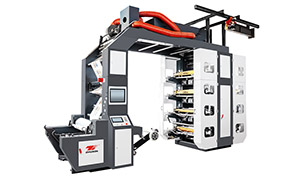
High Speed Flexo Printing Machine - Stack Flexo Flexo Printing Machine
Tension zoning is achieved by using multiple driven roller sections, each with its own torque control. Between zones, a dancer roller or a load cell acts as an isolation element, ensuring that tension fluctuations in one zone do not propagate to others. For instance, the printing zone may have a dancer that maintains a constant tension of 1.5 N/cm, while the die-cutting zone has a separate dancer set at 1.0 N/cm. The dancers are not physically connected, allowing independent control. The control system uses PID loops to adjust the motor torque of each driven section based on the dancer position or load cell reading.
Stretch compensation: As the web moves from printing to converting, it may stretch or relax. For example, after printing, the web may be heated and dried, causing it to shrink; conversely, if it absorbs moisture, it may swell. The tension profiling system must account for these changes. Some inline lines include a measurement of web length between marks (using encoders) to calculate actual stretch, and the converting unit's phase is adjusted accordingly. This is often integrated with the cut-to-print registration control.
Special considerations for laminating: When a laminating unit adds a second web, the tension of both webs must be matched to prevent wrinkling or adhesive failure. The laminating nip has its own tension sensors, and the feed rollers for the second web are controlled to match the primary web's tension. This requires a separate tension zone with its own dancer.
Managing slack and wrinkles: If the tension is too low, the web may become slack and wrinkle, especially around rollers. If too high, it can stretch and cause register errors. The tension profile must be optimized by considering the substrate's stiffness and width. For wide webs (e.g., 2 meters), the tension must be higher to maintain flatness; for narrow webs, lower tension is sufficient. The profile can be set manually or automatically by a tension optimization algorithm that uses the substrate's elastic modulus (known from the material database) to calculate the minimum tension needed to avoid wrinkles without overstretching.
Dynamic tension during start/stop: During acceleration, the web's inertia requires a temporary tension increase to avoid slippage. The control system uses a "tension ramp" that increases tension slightly during speed changes, then returns to the setpoint. This is synchronized across all zones to prevent tension differentials that could break the web.
Monitoring and alarms: Tension sensors at key points provide real-time data. If tension deviates by more than ±10% from setpoint, an alarm is triggered. The system can automatically adjust the dancer or motor torque to correct. Historical tension data is logged for quality analysis – abnormal tension patterns may indicate worn bearings, sticky rollers, or substrate property changes.
By implementing precise tension profiling and isolation,
inline flexo presses can run a wide variety of substrates, from lightweight films to heavy boards, while maintaining high print quality and converting accuracy. The integration of advanced tension control algorithms with the press's main control system has become a key differentiator for modern inline lines, enabling higher speeds, reduced waste, and longer tool life.