Hydrodynamic Pressure Principle of Doctor Blade and Ink Scraping Uniformity Control
This technical article reveals hydrodynamic pressure formation mechanism between doctor blade and anilox roller surface, analyzes fluid field distribution in closed ink chamber, and provides optimized blade angle and pressure parameters for stable ink metering.
Doctor blade ink scraping effect is not only determined by mechanical contact pressure, but also affected by hydrodynamic pressure generated by rotating ink fluid between blade and roller surface. Under high-speed roller rotation, flowing flexo ink forms dynamic liquid pressure, which pushes the blade slightly away from the roller surface and changes actual effective scraping gap. This hydrodynamic effect is the main cause of unstable ink metering at high printing speed.
Three core adjustable parameters control doctor blade scraping performance: blade installation angle, linear contact pressure and blade overhang length. These three parameters jointly determine the thickness of residual ink film on anilox roller surface. Improper parameter matching leads to either residual floating ink or excessive blade wear and roller surface abrasion.
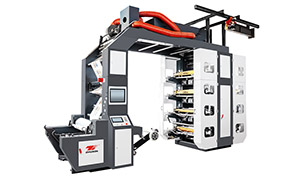
High Speed Flexo Printing Machine - Stack Flexo Flexo Printing Machine
Optimal blade installation angle range varies with printing speed. At running speed below 200m/min, the best blade angle is 28 to 32 degrees to maintain stable contact. At high speed above 350m/min, the angle needs to be adjusted to 35 to 38 degrees to offset rising hydrodynamic pressure. Fixed blade angle cannot adapt to variable speed production and brings periodic ink metering deviation.
Blade overhang length directly affects blade flexibility and contact uniformity. Too short overhang makes blade too rigid, resulting in uneven contact pressure and transverse striped defects. Too long overhang causes blade vibration under high-speed ink fluid impact, generating longitudinal fine stripes. The recommended standard overhang length for flexo
doctor blades is 4mm to 6mm for universal production scenarios.
Fluid field optimization inside closed chambered doctor blade system reduces hydrodynamic interference. The optimized ink chamber adds internal flow baffles to stabilize ink circulation velocity near blade contact area, restraining turbulent ink flow and dynamic pressure fluctuation. After fluid field optimization, high-speed ink metering deviation is reduced by 42%, greatly improving full-web ink color uniformity.
Blade parallelism error is easily overlooked but critical for scraping quality. A 0.02mm parallelism deviation between blade and roller will cause visible transverse color difference across printing width. High-precision automatic blade parallel calibration system is necessary for modern high-speed flexo presses to keep consistent linear contact pressure along full blade length.