Flexographic Printing Machine Plate Mounting and Registration Dynamics
The registration accuracy of a flexographic printing machine is fundamentally influenced by how the printing plate is mounted on its cylinder or sleeve. Plate mounting involves stretching the plate over the cylinder surface, which introduces a controlled strain that affects the print repeat length. This article examines the physics of plate mounting, the selection of mounting tapes, and the dynamic correction of register errors caused by plate stretch variations.
When a photopolymer plate is mounted on a cylinder, it is typically stretched by 0.5-2% to ensure a tight fit without wrinkles. The plate's elastic modulus and thickness determine the force required; the mounting tape's adhesive and foam layer contribute to the effective stiffness. The repeat length of the print is directly proportional to the cylinder circumference plus the plate and tape thicknesses: L = π × (D_cylinder + 2 × (t_plate + t_tape)) × (1 + ε_mount), where ε_mount is the mounting strain. If the plate is stretched more on one job than another, the repeat length changes, causing register errors if the same cylinder is used for multiple jobs without adjustment.
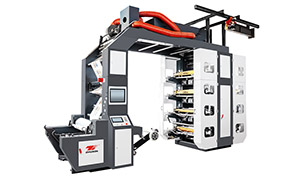
High Speed Flexo Printing Machine - Stack Flexo Flexo Printing Machine
Mounting tape technology: Tapes are available with different foam compressibility (e.g., 0.2 mm, 0.5 mm thickness) and adhesive properties. The foam provides a cushion that absorbs impression pressure, reducing dot gain. However, the foam also compresses under pressure, effectively reducing the plate thickness. This compression is non-linear; the mounting tape's compression curve must be known to predict the effective repeat length. Some tapes have a dual-layer construction: a firm base for stability and a soft top layer for cushioning. The choice of tape is based on the desired dot gain and the substrate's roughness – softer tape for rough substrates, firmer for smooth.
Mounting procedures: Modern flexographic machines use optical or laser projection systems to accurately position the plate on the sleeve or cylinder. The plate is placed on a mounting table with a grid reference, and the image is aligned to the cylinder's zero point. The mounting strain is controlled by applying the plate evenly; some systems use a pneumatic roller to press the plate onto the tape, ensuring uniform adhesion. The mounting accuracy is typically within ±0.05 mm in both circumferential and lateral directions.
Dynamic register correction: Despite careful mounting, the plate may stretch or slip during printing due to centrifugal forces and impression pressure. The machine's register control system continuously monitors printed marks and adjusts the plate cylinder phase. However, this adjustment is based on the actual position of the printed mark relative to the reference; it cannot correct for a systematic repeat length error caused by mounting. Therefore, the machine must be calibrated for each plate-cylinder-substrate combination. Some presses store a "plate characteristic" that includes the mounting strain and tape compression, so the system can pre-compensate the phase offset.
Sleeve technology: Sleeves eliminate the need for direct plate mounting on metal cylinders; the plate is mounted on the sleeve separately, and the sleeve is then slipped onto an air mandrel. This allows the mounting to be done offline on a dedicated mounting machine, where the strain is precisely controlled. The sleeve's inner diameter and wall thickness are chosen to match the desired repeat length. The sleeve material (often a composite with a foam layer) provides consistent cushioning, reducing variability. This off-press mounting improves register accuracy and reduces setup time.
Thermal effects on mounting: Temperature changes affect the plate and cylinder dimensions. The plate material (photopolymer) has a thermal expansion coefficient of approximately 10-15×10^-5 /°C, higher than steel. A 10°C rise can cause a 0.1% change in repeat length, which is significant. Therefore, the mounting and printing environment should be temperature-controlled. Some machines include a plate conditioning unit that brings the plate to the press temperature before mounting.
Maintenance and calibration: Regularly verify the mounting accuracy by printing a test form with registration marks and measuring the repeat length. If a drift is detected, the mounting tape may have degraded or the cylinder surface may be worn. Recalibrate the mounting equipment periodically using a master gauge. By mastering the plate mounting dynamics,
flexographic printing machines achieve the tight registration required for high-quality multi-color printing, reducing waste and ensuring consistency across long runs.