Flexographic Printing Machine Energy Efficiency: Optimizing Drying and Curing Power
Energy consumption is a significant operating cost for flexographic printing machines, with drying and curing systems accounting for 60-80% of the total electrical and thermal energy usage. As sustainability and cost pressures rise, optimizing energy efficiency has become a priority for machine manufacturers and converters. This article examines the energy flows in flexo machines and presents engineering solutions for reducing consumption.
The largest energy consumer is the drying section for water-based and solvent-based inks. Hot air dryers use electric heaters or gas burners to raise air temperature, and large fans to circulate the air. The energy required to evaporate water is about 2.3 MJ per kg of water evaporated, plus sensible heat to raise the substrate temperature. In practice, the efficiency of a hot air dryer is 40-60% because of heat losses to the surroundings and exhaust air. The exhaust air contains considerable energy; heat recovery systems (e.g., plate heat exchangers or rotary thermal wheels) can reclaim 50-70% of this heat to pre-heat incoming air, reducing fuel consumption by 25-40%.
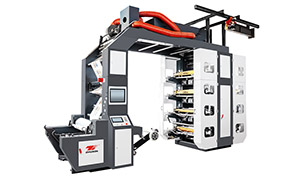
High Speed Flexo Printing Machine - Stack Flexo Flexo Printing Machine
Optimizing air flow: The dryer's air velocity and temperature should be matched to the ink's evaporation rate. Over-drying wastes energy; under-drying requires slower speeds. Modern presses use variable frequency drives (VFDs) on fans to adjust air flow based on press speed and ink coverage, saving 20-30% fan energy. Additionally, the dryer's nozzle design can be optimized for higher impingement efficiency, allowing lower air temperatures for the same drying rate, which reduces energy input.
UV curing efficiency: Mercury arc lamps are notoriously inefficient – only 20-30% of the electrical input is converted to UV; the rest is heat and visible light. UV LED systems are much more efficient, with 40-50% electrical-to-UV conversion and no IR heat, saving 50-60% energy compared to mercury lamps. The LED's instant-on capability eliminates warm-up energy waste. Although LED lamps have higher initial cost, the energy savings typically pay back in 1-2 years.
Use of IR for water-based inks: Infrared dryers can be used as a booster to pre-heat the web, reducing the load on hot air dryers. IR energy is absorbed directly by the ink, with less heat loss to air. However, IR is best used for thin ink layers; for heavy coverage, hot air is still more effective. A combination system with IR pre-dry followed by hot air has been shown to reduce total energy by 15-20%.
Heat recovery from the press: The press's cooling water (for chill rollers and central drum) carries away heat. This heat can be recovered and used for space heating or to pre-heat process water. Some presses use a heat pump to upgrade this low-grade heat to a higher temperature for other applications.
Smart energy management: The press control system can implement an energy management algorithm that adjusts drying power based on real-time measurement of ink wetness (using IR moisture sensors). Instead of running dryers at a fixed setting, the system modulates power to maintain just the right dryness at the exit, minimizing over-drying. The system also shuts down dryers when the press is stopped (e.g., during changeover) to avoid waste.
Material-related savings: Using thinner substrates reduces the thermal mass, requiring less heat to warm the web. Also, inks with higher solids content (less solvent/water) require less energy to dry. Water-based inks with high solid content (e.g., 60-70%) can reduce drying energy by 20% compared to standard formulations.
Benchmarking and monitoring: Many converters track energy consumption per square meter printed as a key performance indicator. The machine's energy monitoring system provides real-time data, allowing operators to identify energy waste (e.g., a stuck damper). Regular maintenance of heater elements and fan bearings ensures that the system operates at peak efficiency. By integrating these measures,
flexographic printing machines can achieve energy savings of 30-50%, significantly lowering operating costs and carbon footprint while maintaining print quality.