Flexographic Press Hydrodynamics: Ink Transfer and Anilox Metering Principles
The ink transfer process in a flexographic press is a complex hydrodynamic phenomenon involving the filling of anilox cells, the wiping action of the doctor blade, the transfer of ink from anilox to plate, and finally from plate to substrate. Each step is governed by fluid mechanics, surface chemistry, and dynamic conditions. Understanding these principles is crucial for predicting ink film thickness, achieving consistent color, and troubleshooting transfer defects.
The anilox roller, with its engraved cells, acts as a metering device. As the roller rotates through the ink pan, cells are filled by capillary action and hydrodynamic pressure. The cell geometry – volume, depth, opening, and wall angle – determines the maximum ink volume. For a typical 60° hexagonal cell at 400 lpi, the cell volume is about 8-10 cm³/m². The filling efficiency, however, depends on ink viscosity and roller speed; at high speeds, incomplete filling (cavitation) can reduce transferred volume. This is mitigated by using forced-feed chambers that pressurize the ink against the roller, ensuring complete cell filling.
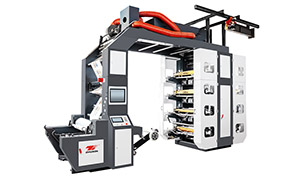
High Speed Flexo Printing Machine - Stack Flexo Flexo Printing Machine
The doctor blade removes excess ink from the aniloy surface, leaving only the ink inside the cells. The blade angle (typically 30-45°) and pressure (5-15 N/cm) influence the wiping quality. A too-aggressive blade pressure can reduce cell volume by deforming the cell walls, while too-light pressure leaves a surface film. The blade's wear pattern creates micro-scratches that change the wiping efficiency over time. The hydrodynamics at the blade tip involve a shear-thinning effect – many flexo inks are non-Newtonian, with viscosity decreasing under shear, so the blade velocity affects the effective viscosity and thus the film left on the surface.
The next step is the ink transfer from anilox to the plate. The plate has a relief pattern; only the raised areas contact the anilox. The contact pressure and the relative speed (typically matched) cause the ink to split, with part of the ink volume transferring to the plate. The split ratio depends on the surface energies of the anilox ceramic (high surface energy) and the photopolymer plate (moderate). The splitting process follows the "Z" or "s" shape of the liquid bridge, and the transferred volume fraction is roughly 40-60% of the cell volume, but it varies with ink viscosity and nip pressure. Higher speed increases the viscoelastic stress, which can enhance or reduce transfer depending on the ink's relaxation time.
Finally, ink transfers from the plate to the substrate under impression pressure. This is a contact printing process where the plate's relief is pressed against the substrate. The transfer efficiency is influenced by substrate surface energy, roughness, and absorbency. For non-porous films, the ink must wet the surface; thus, the ink's surface tension must be lower than the substrate's critical surface tension (e.g., <30 dynes/cm for PE). The impression pressure (typically 0.1-0.5 mm deflection) determines the contact area; higher pressure increases transfer but also increases dot gain and may deform the plate.
Models for predicting ink volume: The total ink transferred per unit area can be approximated as V_total = V_cell × η_fill × η_split × η_transfer, where each efficiency is a function of speed, viscosity, pressure, and materials. Empirical correlations from lab tests are used to calibrate these models for specific ink-substrate combinations. Advanced press controllers use these models to adjust anilox selection, blade pressure, and impression to achieve target densities.
Defects arising from fluid dynamics: "Cell starvation" occurs when ink viscosity is too high or the chamber pressure low, causing incomplete filling – solved by viscosity control and feed pressure adjustment. "Blade strobing" – vibration of the blade creating periodic streaks – addressed by blade damping designs. "Misting" – fine droplets of ink flying off the anilox – caused by high speed and low surface tension; anti-misting additives or enclosed chambers mitigate. The entire fluid system, from ink tank to pump, filters, and return lines, must maintain stable rheology; continuous viscosity monitoring with feedback to solvent/water addition is a standard practice. This hydrodynamic mastery is fundamental to achieving the print consistency and efficiency that modern
flexographic presses demand.