Flexographic Press Architectural Design: CI vs Stack Geometrical Analysis
The architectural choice between a central impression (CI) flexographic press and a stack flexographic press is not merely a matter of preference but a fundamental engineering decision that dictates the press's mechanical stiffness, register performance, accessibility, and substrate range. The CI press arranges all printing decks radially around a single large-diameter central drum, while the stack press aligns decks vertically, each with its own impression cylinder. This geometric distinction leads to profoundly different mechanical behaviors and operational characteristics.
The CI press's key geometric advantage is the short and fixed web path between decks. Since the web wraps around the central drum, the distance from one print nip to the next is determined by the arc angle between decks (typically 60-90°). This short path minimizes substrate stretch between colors, enabling exceptional register accuracy (often ±0.03 mm). The central drum's massive diameter (1.5-2.5 m) provides a large moment of inertia, dampening speed fluctuations. However, this geometry limits the number of decks that can be placed around the drum (usually 6-10) and makes plate changes somewhat cramped, as decks are nested closely.
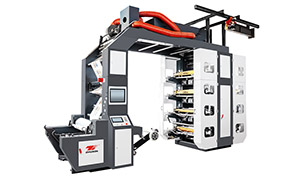
High Speed Flexo Printing Machine - Stack Flexo Flexo Printing Machine
The stack press, in contrast, has a vertical column of decks, each with its own impression cylinder. The web path snakes vertically, resulting in a much longer total web length between decks (typically 3-5 times that of a CI press). This long path makes register control more challenging because any tension variation or substrate stretch accumulates over distance. The stack press requires more sophisticated tension control and often includes additional dancer rollers. However, the open architecture allows easy access to each deck, quick plate changes, and independent impression adjustment for different substrate thicknesses—making it ideal for corrugated board and thick materials that cannot be bent around a small-radius drum.
Mechanical stiffness analysis: The CI press's central drum acts as a massive structural hub, and the decks are mounted on a rigid frame directly tied to the drum bearings. This results in high system stiffness, minimizing relative motion between decks due to frame deflection. In stack presses, each deck is mounted on its own support columns, and the cumulative deflection of the frame under load can cause color-to-color misalignment, especially at high speeds. Advanced stack presses use reinforced box-frame construction and tie-bars to increase stiffness, but they rarely match the CI's intrinsic rigidity.
Accessibility and maintenance: The stack press's vertical layout allows operators to reach each deck from the front and rear, simplifying anilox and plate cleaning. The CI press's radial arrangement confines access; some decks are on the side or behind, requiring specialized tools or remote adjustment. However, modern CI presses use swing-away or slide-out deck assemblies to improve serviceability.
Substrate suitability: CI presses are virtually mandatory for printing on extensible films (PE, PP, PET) because the short web path and consistent drum temperature minimize distortion. The central drum can be water-cooled to maintain constant substrate temperature, crucial for register. Stack presses handle board, paper, and nonwoven effortlessly, but their long web path causes film stretching; thus, they are rarely used for thin films. Some hybrid designs (e.g., CI for the first few colors and stack for additional) exist but are uncommon.
Economic and operational implications: CI presses are more expensive to manufacture due to the large drum and precision bearings, but their superior register and speed (up to 600 m/min) justify the cost for high-volume film packaging. Stack presses are lower-cost and simpler, with shorter setup times for heavy substrates, making them the choice for corrugated and multi-wall bag printing. The press geometry also affects the press footprint – CI presses are compact in length but tall, while stack presses are long and lower-profile, impacting factory layout.
In conclusion, the geometrical design of a
flexographic press is a trade-off among register accuracy, accessibility, substrate versatility, and cost. Engineers must analyze the specific production mix to select the optimal architecture. Emerging designs, such as the "sleeve" CI press with quick-change plate sleeves and the "servo-driven stack" with individual deck motors, are blurring the lines, but the fundamental CI vs stack distinction remains a core consideration in press selection and process design.