Flexo vs Gravure: Process Physics and Transfer Mechanism Comparison
The fundamental difference between flexo and gravure printing lies in the ink transfer mechanism: flexo uses a relief plate and an anilox roller metering system, while gravure uses an engraved cylinder and direct doctor blade wiping. These physical differences lead to distinct print quality attributes, process stability, and substrate suitability. This article provides a technical comparison of the process physics.
In flexo, the ink is first metered by the anilox roller, then transferred to the plate, and finally to the substrate. This multi-step transfer involves fluid splitting at two nips, introducing variability. The impression pressure is relatively low (0.1-0.5 mm deflection) and must be uniform to avoid dot gain. The ink film thickness is limited by the anilox cell volume, and the transfer efficiency is about 40-60% of the cell volume. The process is sensitive to plate deformation and pressure changes.
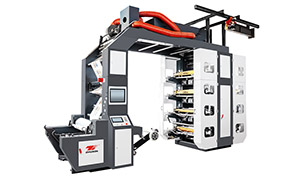
High Speed Flexo Printing Machine - Stack Flexo Flexo Printing Machine
In gravure, the engraved cylinder holds ink in its cells; the doctor blade scrapes the surface clean, leaving ink only in the cells. The substrate is pressed against the cylinder by a rubber impression roller, and the ink is drawn out by capillary action and the mechanical action of the nip. The transfer efficiency is high (70-90% of the cell volume) because the ink is directly transferred from the cells to the substrate. The impression pressure is higher (typically 1-2 mm deflection) and the process is less sensitive to pressure variations, but the cylinder is expensive and time-consuming to engrave.
Print quality: Gravure produces a more uniform ink film with less dot gain, because the cells have precise geometry and the transfer is more direct. Flexo dot gain is inherent due to the plate deformation and the splitting process. Gravure also offers better ink density and coverage, especially for large solids, because the ink film is thicker. However, gravure is prone to "scumming" (ink in non-image areas) if the doctor blade is worn.
Speed and stability: Both can run at high speeds, but gravure is more stable because the cylinder is rigid and the doctor blade provides consistent metering. Flexo's anilox and plate are flexible, leading to more process variability. However, flexo's quick changeover (sleeve technology) gives it an advantage for short runs.
Substrate interaction: Flexo is more forgiving on rough substrates because the plate and impression conform to the surface; gravure requires smooth substrates to achieve good contact and transfer.
Ink formulations: Flexo uses lower-viscosity inks (water-based, UV, solvent) suitable for anilox filling; gravure uses higher-viscosity inks (mostly solvent-based) that stay in the cells. The drying requirements differ; gravure inks have more solvent, so drying is more energy-intensive.
By understanding these physical differences, print buyers and converters can choose the appropriate technology based on the required quality, run length, and substrate, balancing cost and performance.