Flexo vs Gravure: Cost-Benefit Analysis for Packaging Applications
The choice between flexo and gravure for a packaging job is often driven by economics. This article provides a detailed cost-benefit analysis, comparing capital investment, tooling costs, setup time, running costs, and waste, with a focus on break-even run length.
Capital investment: A high-quality CI flexo press (8-color, 1.2 m width) costs approximately $2-4 million, while a comparable gravure press (8-color) costs $3-6 million. The gravure press is more expensive due to the heavier cylinders, higher precision bearings, and the doctor blade systems. Additionally, gravure requires a cylinder engraving facility (which can cost $500k-1M) or outsourcing.
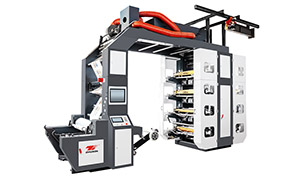
High Speed Flexo Printing Machine - Stack Flexo Flexo Printing Machine
Tooling costs: Flexo plates cost $50-300 each, depending on size and complexity, and can be re-used for multiple runs with some wear. Gravure cylinders cost $1000-5000 each, and are dedicated to a specific job; they are not easily modified. For a 6-color job, flexo tooling might be $500-1500, while gravure tooling is $6000-30000. Thus, flexo has a huge advantage for short runs and frequent design changes.
Setup and changeover: Flexo changeover (including plate mounting, anilox change, registration) takes 10-30 minutes for narrow web, 30-60 minutes for wide web. Gravure changeover requires cylinder handling (heavy), registration setup, and often cleaning of the doctor blade; it takes 60-180 minutes. This makes flexo much more responsive to short runs.
Running costs: Ink consumption is similar, but gravure uses more solvent-based inks (higher energy for drying). Flexo's water-based and UV inks have lower energy costs. The waste per job: flexo makeready waste is 20-50 meters, gravure is 100-300 meters due to longer setup. For long runs, waste is negligible.
Quality: Gravure offers superior and more consistent quality; for high-end products (e.g., premium food packaging), the quality premium may justify the higher cost. Flexo quality is now excellent with advanced plates and controls, but may still show slight dot gain and mottle.
Break-even analysis: For a typical 6-color job on film, the total cost per 1000 linear meters is calculated for both processes. At short runs (<10,000 m), flexo is clearly cheaper due to low tooling and setup. At medium runs (50,000-200,000 m), the two are competitive; the choice depends on quality requirements. Above 500,000 m, gravure becomes cheaper because the cylinder cost is amortized, and its lower running cost (less waste, less energy per meter) dominates. However, these figures vary by region and specifics.
Other factors: Flexo's flexibility for short runs and versioning (e.g., promotional variations) is a major advantage. Gravure's long cylinder life (millions of impressions) and consistent quality make it ideal for long-run commodities like flexible packaging for snacks.
Conclusion: For converters serving diverse customers, flexo is the most versatile and cost-effective. For those with dedicated long-run products, gravure may be chosen. Hybrid solutions (using flexo for color and gravure for special effects) are also emerging. The decision should be based on a thorough cost model tailored to the specific production mix.