Flexo Web Guide: Sensor and Actuator Dynamics for High-Speed Lateral Stability
The web guide (or edge guide) is a critical component that ensures the substrate runs straight through the press, preventing wrinkles and maintaining register. At high speeds (>400 m/min), the guide's response time and accuracy must be exceptional. This article analyzes the dynamics of web guide systems and their optimization.
The web guide consists of a sensor that detects the web's lateral position and an actuator that steers the web back to the reference. The sensor is typically an optical or ultrasonic device. Optical sensors use a photodiode array to detect the edge; they have a response time of 0.1-1 ms and a resolution of 0.01 mm. Ultrasonic sensors are less precise but work on transparent films. The sensor must be positioned in a stable location, away from splices or edge damage, and its output is filtered to remove noise.
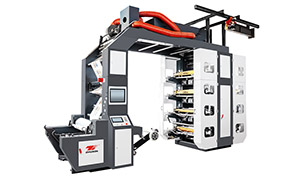
High Speed Flexo Printing Machine - Stack Flexo Flexo Printing Machine
The actuator is a steering frame that pivots a roller or a pair of rollers. The actuator has a servo motor (or hydraulic cylinder) with a position encoder. The steering angle must be proportional to the error signal. The dynamics of the actuator are described by its bandwidth (the frequency at which it can respond). Typical bandwidths are 5-10 Hz, sufficient to correct low-frequency web wander. However, at high speeds, higher frequencies (e.g., from splices) require faster response. Some systems use a "fast actuator" with a bandwidth of 20 Hz for critical applications.
Control algorithms: The most common is a PID controller with a feedforward term based on the web speed. The controller gain is tuned to achieve a critically damped response – not too slow (allowing wander) and not too fast (causing oscillation). The feedforward term compensates for the changing web width (due to tension variations) and the response delay. Advanced systems use adaptive control that adjusts the gains based on the web's stiffness and speed, learned from a self-tuning routine.
Guide placement: The guide should be placed as close as possible to the first printing deck, and additional guides may be placed before critical converting units. The distance between the guide and the printing nip affects the response time; a shorter distance improves accuracy but may cause interference. Some presses use a "central guide" that keeps the web centered, rather than edge-guided, which is useful when the web width varies.
Web wander sources: The main causes of web wander are roller misalignment, uneven tension, and thermal expansion. The guide corrects lateral displacement, but if the wander is cyclic (e.g., from a misaligned roller), it may require repeated corrections. Identifying and eliminating the source is better than relying solely on the guide.
Maintenance: The sensor window must be kept clean; dust or ink mist can cause false readings. The actuator mechanism must be lubricated and free of backlash. The guide's calibration should be checked periodically using a test roll with known offset. Regular inspection of the guide's mounting bolts and the pivot bearings is essential. By properly tuning and maintaining the web guide, flexo presses achieve stable web positioning, reducing edge trimming waste and improving print registration.