Flexo Web Guide: Integration with Tension Control for Dynamic Web Steering and Stability
The web guide does not operate in isolation; it interacts with the tension control system. Changes in tension cause the web to shift laterally, and the guide's correction can, in turn, affect tension. This article examines the coupling between these systems and the coordinated control strategies to prevent oscillations.
The coupling mechanism: When the guide steers the web, it changes the web path length and the angle of approach to the next roller, which alters the tension. For example, a lateral shift can cause the web to rub against the side of a roller, increasing drag. If the tension controller responds to this drag, it may adjust the motor torque, which then affects the lateral position. This positive feedback can lead to low-frequency oscillations (hunting) of both tension and position.
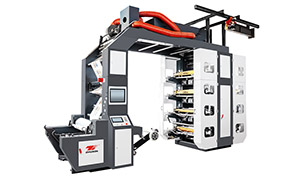
High Speed Flexo Printing Machine - Stack Flexo Flexo Printing Machine
Coordinated control: Modern presses use a centralized control system that manages both tension and guide. The guide controller sends its correction signal to the tension controller, which adjusts its setpoint to compensate for the expected tension change. This is a feedforward compensation that decouples the two loops. Additionally, the guide controller receives the tension error signal and modifies its correction to avoid exciting the tension loop. The design of this coordinated control is based on a state-space model of the web's mechanical behavior.
Tuning the guide with tension variations: During acceleration or deceleration, the web tension changes, causing lateral wander due to the Poisson effect (the web narrows under tension). The guide must anticipate this by using a speed-dependent offset. Some systems have a "tension feedforward" that adjusts the guide's reference position based on the tension setpoint, pre-emptively steering the web to the correct lateral position.
Anti-oscillation strategies: To prevent hunting, the guide's bandwidth is limited to be lower than the tension loop's bandwidth, so that the guide does not respond to high-frequency tension noise. Additionally, the guide uses a "dead zone" – a small tolerance (e.g., ±0.5 mm) where no correction is made – to avoid over-correcting for minor deviations. The dead zone is adaptive: larger at high speeds to prevent oscillation, smaller at low speeds for accuracy.
Practical considerations: The guide and tension sensors should be placed at specific points to minimize coupling. For example, placing the guide sensor after a tension isolation dancer reduces the influence of tension. The actuators for guide and tension should be mechanically isolated; the guide steering roller should have low inertia to avoid affecting tension.
Monitoring: The system logs both lateral position and tension. If oscillations are detected, the correlation between them reveals the coupling. The gains can be adjusted or a notch filter can be introduced to suppress the oscillation frequency. Regular re-tuning after any mechanical changes (e.g., roller replacement) is recommended. By integrating guide and tension control in a coordinated manner, flexo presses achieve stable web behavior, reducing waste and improving print consistency even during speed ramps.