Flexo Unwind: Tension Control and Dancer Dynamics for Stable Web Feeding
The unwind station is the starting point of the flexo press, responsible for delivering the substrate at a constant tension to the printing section. The tension must be stable despite the roll diameter decreasing as it unwinds, and the changing inertia requires dynamic control. This article examines the physics and control of the unwind system.
The unwind consists of a roll support (shafted or shaftless), a motor that brakes or drives the roll, a dancer roller (or load cell), and a control loop. The motor torque is set to oppose the web pull from the downstream, creating tension. The basic equation: Tension = Motor Torque / Roll Radius. As the radius decreases, the torque must decrease proportionally to maintain constant tension. The motor is typically an AC servo with regenerative braking, capable of both motoring and braking.
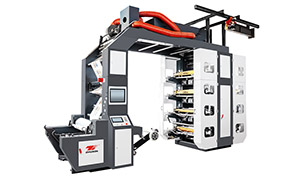
High Speed Flexo Printing Machine - Stack Flexo Flexo Printing Machine
The dancer roller is a weighted or pneumatically loaded roller that moves vertically (or horizontally) to absorb tension variations. Its position is measured by a potentiometer or encoder. The dancer's inertia and the air pressure determine its response. The dancer acts as a mechanical low-pass filter, smoothing out high-frequency tension disturbances. The control loop (PID) adjusts the motor torque to keep the dancer at its neutral position. The dancer also provides a visual indication of tension.
Inertia compensation: During acceleration or deceleration, the roll's inertia creates a torque that must be overcome. The motor must provide additional torque during acceleration to speed up the roll, and absorb torque during deceleration. The control system calculates the inertia based on the roll's mass and radius (known from the roll diameter sensor) and adds a feedforward torque. Without this, tension dips or spikes occur.
Roll diameter measurement: An ultrasonic or laser sensor measures the roll diameter continuously. The diameter is used in the torque calculation and to estimate the remaining web length. The system also uses the diameter to anticipate the end of the roll for splicing. Accurate diameter measurement is critical; a 1% error in diameter can cause a 1% tension error.
Splicing: The unwind often includes a splice table for splicing a new roll to the expiring one. The splice must be made at the correct tension to avoid web breaks. The dancer provides a buffer of web length (1-2 meters) to allow the splice to be made without stopping the press. The splice tape must be applied smoothly; a wrinkled splice can cause the web to break at the first roller.
Tension setpoint selection: The tension is set based on the substrate's elastic modulus and width. For films, low tension (0.3-0.8 N/cm) is used; for paper, higher (1-2 N/cm); for board, 2.5-4 N/cm. The setpoint is stored in the job recipe. The tension must be uniform across the width; if the roll has a "telescoped" edge, the tension will be uneven. Proper roll storage and handling prevent this.
Maintenance: The dancer roller bearings must be clean and lubricated; any friction in the dancer affects tension accuracy. The motor brake and gearbox require periodic inspection. The roll diameter sensor must be calibrated. The splice table's tape applicator should be maintained. By properly tuning the unwind tension control, flexo presses achieve stable web entry, which is essential for register and print quality.