Flexo Unwind: Shaftless vs. Shafted Chuck Systems and Roll Loading Automation
The unwind's chuck system is the interface between the press and the substrate roll. Shafted and shaftless systems have different advantages in terms of handling, core compatibility, and automation. This article compares the two and discusses roll loading automation.
Shafted unwinds use a through-axle (shaft) that is inserted into the core of the roll. The shaft ends are clamped in bearings on both sides. The shaft must match the core's inner diameter (e.g., 3-inch or 6-inch). Shafted systems are simple and robust, but loading requires inserting the shaft, which can be heavy and time-consuming. The shaft also adds weight to the roll, increasing inertia. For heavy rolls (>500 kg), the shaft is often pre-inserted using a hoist.
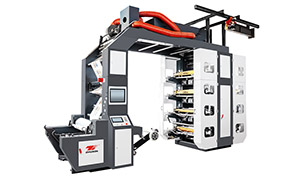
High Speed Flexo Printing Machine - Stack Flexo Flexo Printing Machine
Shaftless unwinds have chucks that grip the core from both ends without a full shaft. The chucks are hydraulically or pneumatically actuated and can accommodate a range of core diameters (e.g., 70-100 mm). Loading is faster: the roll is placed between the chucks, and the chucks expand to grip the core. This reduces operator effort and the need for a shaft inventory. Shaftless systems are becoming standard for wide-web presses and heavy rolls. They also allow for easier removal of waste cores.
Core gripping force: The chucks must exert enough force to transmit the motor torque without slipping, but not so much as to crush the core. The force is controlled by hydraulic pressure or air pressure. The chuck surface has a non-slip pattern (e.g., rubber or knurled steel) to enhance grip. For multi-layer cores, the chuck must not delaminate the core.
Automated roll loading: Some unwinds are equipped with a roll loading trolley that picks up the roll from the floor, positions it, and automatically engages the chucks. The trolley can be integrated with the warehouse system; the operator selects the roll by barcode, and the system loads it. This reduces ergonomic strain and minimizes loading time to under 2 minutes. The trolley may also include an automatic core remover for empty cores.
Core preparation: The core must be clean and the edges square. The adhesive tape for splicing must be applied in the correct position. Some systems have an automatic core prepper that applies tape and centers the core.
Safety: The loading area must have light curtains and emergency stops. The chucks should not engage if an operator is in the danger zone. The roll must be secured against accidental roll-off.
Maintenance: The chucks need regular cleaning and lubrication. The hydraulic or pneumatic cylinders should be checked for leaks. The sensors that detect core presence must be cleaned. The trolley's wheels and guides need maintenance. By choosing the right chuck system and automation level, converters can reduce changeover time and operator fatigue, improving overall productivity.