Flexo UV Curing: Photopolymerization Kinetics and Dose Optimization for Full Cure
UV curing is a photochemical process where photoinitiators generate reactive species that polymerize monomers and oligomers into a crosslinked network. Understanding the kinetics is essential to select the right UV lamp power and press speed for full cure. This article presents the kinetic model and optimization guidelines.
The polymerization rate (R_p) is proportional to the square root of the intensity (I) and the photoinitiator concentration [PI]: R_p = k × (I × [PI])^0.5, where k is a constant. The degree of conversion (α) follows an S-curve: initially slow (induction period), then auto-accelerates due to the Trommsdorff effect (increased viscosity reduces termination), and finally plateaus when monomer mobility is limited. For most UV flexo inks, the maximum conversion is 80-95%.
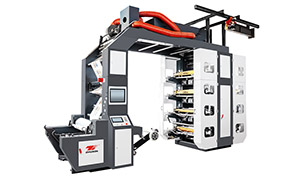
High Speed Flexo Printing Machine - Stack Flexo Flexo Printing Machine
The dose (energy per area, J/cm²) required for ≥90% conversion depends on the ink's absorbance and the film thickness. For a clear ink, a dose of 100-200 mJ/cm² may suffice; for pigmented inks (especially white with TiO₂), 300-600 mJ/cm² may be needed because pigments absorb UV. The Beer-Lambert law applies: I(z) = I_0 × exp(-ε × c × z), where I_0 is the incident intensity, ε is the extinction coefficient, c is pigment concentration, and z is depth. The dose at the bottom of the film must be sufficient to initiate polymerization; thus, the top dose must be higher to compensate for absorption.
Photoinitiator selection: The PI's absorption spectrum must match the lamp's emission spectrum. For mercury lamps, broad-spectrum PIs are used; for LED, the PI must absorb at the specific LED wavelength (365 nm or 385 nm). The PI concentration is typically 2-6% of the ink weight; too low gives slow cure, too high causes yellowing and migration. A combination of two PIs (one for surface, one for deep cure) can improve through-cure.
Oxygen inhibition: Atmospheric oxygen reacts with radicals, inhibiting cure at the surface. To counter, use amine synergists that consume oxygen, or increase the dose to overcome the inhibition period. In some cases, an inert atmosphere (nitrogen) is used to reduce oxygen, but this is costly and less common in flexo.
Cure verification: Degree of cure is assessed by the solvent rub test (MEK double rubs) or by measuring the gel content. A fully cured film should withstand at least 50 rubs without losing gloss. In-line, the UV power and press speed are monitored; the system adjusts the lamp power if the speed changes to maintain a constant dose. The lamp's output degrades over time; a UV sensor tracks the intensity and alerts when it drops below a threshold.
Troubleshooting: Poor cure (tacky surface, poor scratch resistance) is often due to insufficient dose, wrong PI, or oxygen inhibition. Increase lamp power or reduce speed; add more PI; use a nitrogen blanket. Over-cure (yellowing, brittleness) is caused by excess dose; reduce power or increase speed. By mastering UV curing kinetics, converters achieve fast, reliable cure, enabling high-speed printing with excellent final properties.