Flexo UV Curing: Lamp Technologies and Thermal Management for Heat-Sensitive Substrates
The choice of UV lamp technology affects not only curing performance but also heat generation, energy consumption, and substrate compatibility. This article compares the main lamp types and discusses thermal management strategies for heat-sensitive materials.
Mercury arc lamps: These are the traditional UV lamps, with a quartz tube filled with mercury vapor. They emit a broad spectrum (UVA, UVB, UVC) and high intensity (up to 200 W/cm). However, they generate significant IR heat (about 60-70% of input energy), which can damage films. They have a limited life (500-1000 hours) and require warm-up time. They are relatively low-cost and widely used for general applications where heat is not a concern.
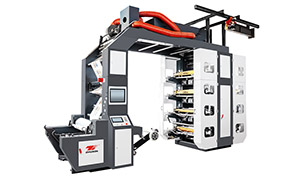
High Speed Flexo Printing Machine - Stack Flexo Flexo Printing Machine
Microwave-powered lamps: These use microwave energy to excite mercury, similar to arc lamps but with longer life (2000-5000 hours) and instant on/off. They also generate less heat and have more uniform emission. However, they are more expensive and require specialized microwave generators. They are used in some CI presses for flexible packaging.
UV LED: As discussed, LED emits a narrow band (365, 385, 395 nm) with no IR heat. They are instant-on, have long life (20,000+ hours), and are energy-efficient (40-50% electrical-to-UV vs. 20-30% for arc). They are the preferred choice for heat-sensitive films (PE, PP, PVC, OPS) and shrink sleeves. The main limitation: they require specially formulated inks with matching PIs. Also, the curing depth may be less than with broad-spectrum lamps.
Thermal management: With arc lamps, the heat must be removed from the lamp housing and the web. The housing has a cooling air blower and water-cooled reflectors. The air is exhausted, often with a heat exchanger to recover heat. To protect the web, a cold mirror reflector (which reflects UV but transmits IR) can be used, or a heat-absorbing glass filter. The distance between the lamp and the web must be adjusted to balance UV intensity and heat; typically 50-150 mm.
Cooling the web: For heat-sensitive substrates, a chill roller behind the web (on the opposite side) removes heat. The roller is cooled by chilled water at 10-20°C. The web's temperature should be monitored with an IR thermometer; if it exceeds the substrate's softening point (e.g., 60°C for PE), the speed must be reduced or additional cooling applied.
Energy and cost comparison: LED curing uses 50-70% less electricity than arc lamps, and since there is no heat, it reduces the load on chillers and air conditioning. The lamp replacement cost is lower over the life. However, the initial cost of LED is higher. The payback period for LED vs. mercury is typically 1-2 years based on energy savings alone.
Maintenance: Mercury lamps need periodic replacement and reflector cleaning (reflectors lose efficiency). Microwave lamps need magnetron maintenance. LED modules need only cleaning of the protective window. By selecting the appropriate lamp technology and implementing effective thermal management, flexo converters can achieve high curing performance on any substrate, with optimal energy efficiency and minimal heat damage.