Flexo Substrate Types: Physical Properties and Printing Suitability Matrix
Flexo printing is versatile across a wide range of substrates, but each substrate has unique physical properties that affect print quality, press settings, and ink selection. This article provides a comprehensive characterization of major substrate categories and a guide to matching them with appropriate process parameters.
Substrate properties critical for flexo: Surface energy (for adhesion), porosity (for ink absorption), smoothness (for dot resolution), tensile strength and elastic modulus (for tension and register), and thermal stability (for drying). These properties are measured by standardized tests: surface energy via dyne pens, porosity by Gurley or Bendtsen, smoothness by Bekk or PPS, and tensile properties by universal testing machine.
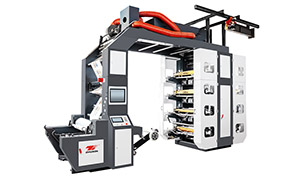
High Speed Flexo Printing Machine - Stack Flexo Flexo Printing Machine
Films (PE, PP, PET, OPS, PVC): Non-porous, low surface energy (untreated), require corona or primer treatment. Smooth surface enables high-resolution printing (up to 175 lpi). Low elastic modulus (200-1000 MPa) requires precise tension control and low impression to avoid stretching. Thermal shrinkage can be significant (especially OPS, PVC), so drying temperatures must be low. Typically printed with UV or solvent inks; water-based inks need special formulations. Suitable for flexible packaging, shrink sleeves, labels.
Paper (coated, uncoated, kraft): Porous, high surface energy (40-50 dynes/cm), no treatment needed. Absorbent, so water-based inks dry by absorption and evaporation. Smoothness varies: coated paper (e.g., C1S) can achieve 150 lpi; uncoated (e.g., kraft) limited to 80-100 lpi. Higher elastic modulus (5-10 GPa) allows higher tension. Moisture sensitivity causes dimensional changes; humidity control is important. Inks: water-based, UV (for coated), solvent (rare). Applications: labels, bags, envelopes, wrapping.
Board (corrugated, paperboard, carton board): Thick, rough, porous, high surface energy. Corrugated has flute structure, requiring deep impression and soft impression rolls to avoid crushing. Resolution limited to 80-100 lpi. High stiffness allows high tension. Ink: water-based (dominant) due to absorption; UV for premium cartons. Applications: shipping boxes, folding cartons, displays.
Nonwoven (synthetic or natural fiber webs): Porous, low to medium surface energy, variable smoothness. Absorbent, so water-based inks work well. Elastic modulus depends on fiber composition (e.g., polypropylene nonwoven is more extensible). Temperature-sensitive (low melting point for some synthetics). Inks: water-based or UV (if cured without high heat). Applications: hygiene products (diapers, wipes), medical gowns, filtration media.
Suitability matrix: For each substrate, the recommended anilox line screen, ink type, impression pressure, and drying method are provided. For example, films: high lpi (800-1200), low volume anilox, UV inks, low pressure, low temperature drying. Paper: medium lpi (400-700), water-based inks, moderate pressure, hot air drying. Board: low lpi (200-400), water-based inks, high pressure (with compliant impression), hot air. Nonwoven: medium lpi (400-600), water-based inks, moderate pressure, hot air.
By understanding substrate properties, converters can select the optimal process parameters and avoid common issues like poor adhesion, dot gain, and substrate deformation. This knowledge is the foundation for consistent quality across diverse product portfolios.