Flexo Substrate Types: Influence of Porosity and Absorbency on Ink Drying and Final Properties
The porosity and absorbency of the substrate directly influence the drying mechanism of ink and the final print characteristics. Porous substrates (paper, board, nonwoven) allow ink solvent (water) to penetrate, while non-porous substrates (films) require evaporation of all solvents. This difference fundamentally alters the ink formulation and press operation.
On porous substrates, the ink penetrates the surface, reducing the need for extensive evaporation. The penetration depth depends on the pore size and the ink's viscosity. For uncoated paper, the ink wicks into the fibers, leaving a thinner resin film on the surface, which reduces gloss and rub resistance but provides fast "set-off" – the ink dries quickly enough to allow immediate stacking. The absorption also reduces the required drying energy, as a significant portion of water is drawn into the substrate. However, excessive penetration (strike-through) can cause show-through on the reverse side.
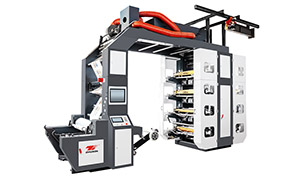
High Speed Flexo Printing Machine - Stack Flexo Flexo Printing Machine
On non-porous substrates, the ink stays on the surface; all solvents must be evaporated (or cured). This requires higher drying energy and longer dryer tunnels. The ink film remains on the surface, resulting in high gloss and good rub resistance. However, the film is more sensitive to blocking (sticking to the next layer) if not fully cured. The adhesion is purely physical or chemical, so surface treatment is critical.
Measuring porosity: The Gurley densometer measures the time for air to pass through a standard area; higher time means lower porosity. For board, the Bendtsen roughness and porosity tests are common. The ink's absorption rate can be measured with a dynamic absorption tester (e.g., a droplet absorption time). These data help to select the appropriate ink: for high-porosity substrates, higher viscosity and faster-drying inks are used; for low-porosity, lower viscosity and slower drying to allow leveling.
Effect on print properties: On porous substrates, the ink penetrates, reducing the color density for a given ink volume; therefore, higher anilox volume may be needed. The dot gain is also affected – on rough surfaces, the ink spreads, increasing gain. On non-porous, the dot gain is mainly from pressure and wetting; the gain is lower and more consistent.
Coating the substrate: Applying a coating (e.g., primer, clay coating) reduces porosity and increases smoothness, allowing better print quality. This is common for premium paper and board. The coating also reduces ink absorption, making drying more dependent on evaporation, but improves gloss and density.
Practical guidelines: For porous substrates, use higher solids content inks to minimize penetration, and ensure the drying system has good air flow but can be less intensive. For non-porous, use lower viscosity inks with fast evaporation or curing, and provide high drying capacity. By understanding the interaction between substrate porosity and ink behavior, converters can optimize print quality and productivity for each material.