Flexo Rewind: Winding Dynamics and Roll Quality Control for Web Tension Management
The rewind unit is the final station where the printed web is wound into a roll. The quality of the rewind roll directly affects downstream converting (slitting, bag-making) and customer satisfaction. Poor winding causes telescoping, blocking, or core damage. This article analyzes the winding dynamics and control strategies to produce defect-free rolls.
The winding process involves three main parameters: tension, nip pressure, and winding speed. As the roll diameter increases, the rotational speed decreases to maintain constant line speed. The tension must be controlled to avoid internal stresses that cause roll defects. The tension profile is typically tapered: high tension at the core to prevent slipping, gradually decreasing as the roll builds to avoid crushing the inner layers. The taper percentage (e.g., 10-20%) is set based on the substrate stiffness; for soft films, more taper is needed.
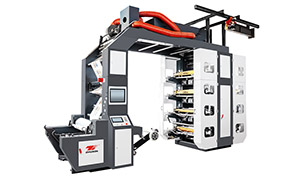
High Speed Flexo Printing Machine - Stack Flexo Flexo Printing Machine
Roll hardness is a critical quality metric. It is measured as the density of the roll (kg/m³) or by a durometer. Too soft a roll can deform during storage; too hard creates high internal stress, leading to "star" or "gusset" defects (radial wrinkles). The hardness is controlled by the winding tension and nip pressure. The nip pressure (from a driven or idler roller) determines the contact force at the point of roll contact. A higher nip pressure gives a harder roll but may cause crushing. The optimal setting is determined by trial.
Telescoping occurs when the roll layers slip sideways, causing the edges to protrude. This is caused by too low tension at the edges or by the web's lateral wander. To prevent, the rewind uses a "differential winding" where the core rotates at the correct speed, and a lay-on roller applies consistent pressure across the width. The web guide before the rewind ensures the web is centered. Also, the use of a "spread" roller (with a slight bow) helps to keep the web flat.
Blocking: When the printed side contacts the back of the previous layer under pressure, it can stick (block). This is prevented by ensuring the ink is fully dried/cured before rewinding, and by using an anti-blocking additive in the ink. The rewind tension must be low enough to minimize interlayer pressure. Some presses have a cooling section before the rewind to bring the web to ambient temperature, reducing tack.
Core selection and chucking: The core (usually cardboard or plastic) must be strong enough to support the roll weight. The rewind's chuck (core grip) must hold the core without slipping; worn chucks cause core rotation and uneven winding. Regular inspection of the chuck and the core's inner diameter is essential.
Automation: Turret rewind systems allow automatic roll changeover at full speed, with a pre-loaded core, adhesive application, and cut-off knife. This reduces downtime and waste. The system monitors the roll diameter and automatically initiates the change. The finished roll is then weighed and labeled. By controlling winding parameters precisely,
flexo rewinds produce rolls with consistent hardness and diameter, ready for the next process.