Flexo Rewind: Automatic Roll Changeover and Slitting Integration for Continuous Production
In high-volume flexo production, the rewind must operate continuously without stopping for roll changes. Turret rewinds with automatic roll changeover and integrated slitting enable this, but they introduce dynamic challenges during the transfer. This article examines the mechanics and controls of automated rewind systems.
The turret rewind has two or more rewind shafts mounted on a rotating turret. While one shaft is winding, the other is prepared with a new core. When the roll reaches the target diameter, the turret rotates, bringing the new core into the winding position. A cut-off knife severs the web, and the web is automatically wrapped onto the new core using adhesive or a suction system. This entire process takes 2-5 seconds, allowing the press to continue running.
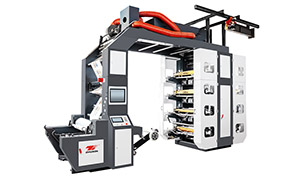
High Speed Flexo Printing Machine - Stack Flexo Flexo Printing Machine
Tension control during changeover: The moment of cut-off and transfer causes a tension disturbance. The unwind and the downstream tension zones must compensate for the momentary loss of load. The control system uses a feedforward signal to the unwinder to maintain tension, and a dancer roller provides a buffer. The cut-off must be clean; a rough cut can cause web breakage. The web's edge must be guided onto the new core; this is achieved by air jets or mechanical guides.
Integrated slitting: Many rewinds include slitting knives that slit the wide web into multiple narrower rolls. The slitting is done just before the rewind, and each slit strand is wound onto separate cores on the same shaft (for multi-shaft winding) or onto individual shafts (for differential winding). The slitting knives must be precisely positioned to match the printed pattern; this requires a mark sensor that registers the print repeat and adjusts the knife position. The knives must be sharp and have minimal contact pressure to avoid dust or blade marks.
Core loading and preparation: The cores are loaded into the turret automatically or manually. The core must have adhesive tape applied to start the winding; some systems use a glue applicator. The core's inner diameter must match the shaft's chuck. For heavy rolls, a core with high crush strength is used. The core length should be 10-20 mm shorter than the web width to allow edge trim.
Waste management: The waste from the cut-off (the tail and the start-up waste) must be diverted to a scrap bin. The system uses a waste gate that opens during the changeover. The waste is typically wound on a separate scrap rewind. Minimizing changeover waste is critical; modern systems waste only 1-2 meters per change.
Maintenance: The turret mechanism requires regular lubrication and inspection of the rotation bearings. The cut-off knife must be replaced periodically; a dull knife causes ragged edges. The slitting knives are inspected for wear and re-sharpened. The adhesive applicator must be kept clean. The turret's alignment to the web path must be checked; any misalignment causes wrinkles. By implementing robust automatic changeover and slitting,
flexo rewinds achieve near-continuous production, significantly improving OEE and reducing labor.