Flexo Registration Control Sensor Technologies: Optical, Ultrasonic, and Camera-Based Systems
The accuracy of flexo registration control hinges on the reliable detection of register marks by sensors. Various technologies are available: optical (visible light) sensors, ultrasonic sensors, and high-speed cameras. Each has strengths and limitations depending on the substrate, ink, and environmental conditions. This article compares these technologies and provides guidance for selection.
Optical sensors are the most common. They use an LED or laser light source and a photodetector to measure the contrast between the register mark and the background. The sensor outputs a signal when the mark passes, and the timing is recorded. Optical sensors work well on opaque substrates with high contrast marks (e.g., black on white). However, they struggle with transparent films (where the mark is less visible) or low-contrast marks (e.g., yellow on white). They are also sensitive to dust and ambient light; some sensors use modulated light to reject ambient interference. The response time is typically 0.1-1 ms, sufficient for high speeds.
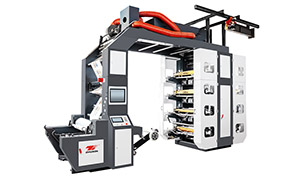
High Speed Flexo Printing Machine - Stack Flexo Flexo Printing Machine
Ultrasonic sensors emit sound waves and detect the echo from the web; they are insensitive to color or transparency, making them ideal for transparent films or low-contrast marks. They work by detecting thickness changes (e.g., a mark with a different density) or surface texture. However, they have lower resolution (about ±0.1 mm) than optical sensors, and their response time is slower (1-5 ms). They are rarely used for high-precision registration but can be used for edge guiding or as a backup.
Camera-based systems (smart cameras or line-scan cameras) are the most advanced. They capture an image of the mark area and use pattern recognition algorithms to locate the mark with sub-pixel accuracy. They can handle multiple marks, variable patterns, and can even detect registration errors in real-time. Cameras offer the highest resolution (down to ±0.005 mm) and can be used for both register and defect detection. However, they are more expensive and require more processing power; the latency is around 1-5 ms depending on the image processing speed. They are becoming standard on high-end presses.
Mark design: For optimal detection, the mark should have high contrast, a simple shape (e.g., a square or line), and be placed in a clean area. The mark size is typically 3-10 mm. For transparent films, a white mark or a mark printed with a highly reflective ink is used. The sensor's detection range and field of view must be adjusted to accommodate web wander.
Environmental robustness: Sensors must be protected from ink mist, dust, and heat. They are often housed in sealed enclosures with air purge. The alignment of the sensor relative to the web must be stable; brackets with lockable adjustments are used. Regular cleaning of the sensor window is essential.
Integration: The sensor outputs a digital signal (e.g., pulse) or a digital value over a fieldbus. The control system receives the signal and calculates the error. For camera systems, the image processing is often done on the camera itself, and the result (position) is sent as a serial or Ethernet message. The sampling frequency must match the press speed; for 600 m/min and a mark spacing of 500 mm, the mark frequency is 20 Hz, easily manageable.
Selection guide: For opaque paper/board with high-contrast marks, optical sensors are cost-effective. For transparent films or difficult contrast, camera-based systems are recommended. For low-speed or less critical applications, ultrasonic may suffice. Many presses use a combination: an optical sensor for normal conditions and a camera for fine-tuning. By choosing the right sensor technology and maintaining it properly, flexo presses achieve reliable registration control with minimal misreads and false corrections.