Flexo Registration Control Closed-Loop Algorithms: PID, Feedforward, and Predictive Compensation
Flexo registration control is a closed-loop system that maintains the alignment of colors by adjusting the phase of each plate cylinder relative to the web. The control algorithm must handle disturbances such as web stretch, speed changes, and mechanical variations. This article examines the underlying algorithms and their tuning for optimal performance.
The basic control loop consists of a mark sensor (optical camera) that detects the position of a register mark printed by each color. The error signal is the difference between the actual mark position and the desired position (setpoint). The controller then sends a correction signal to the servo motor that adjusts the phase of that color's plate cylinder. The simplest controller is a proportional (P) controller, but to eliminate steady-state error, an integral (I) term is added – forming a PI controller. Derivative (D) is rarely used in register control because it amplifies noise.
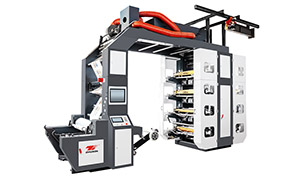
High Speed Flexo Printing Machine - Stack Flexo Flexo Printing Machine
The PI controller's gain parameters (Kp, Ki) must be tuned to the specific press. The process model includes the web's mechanical response: a change in plate cylinder phase shifts the printed mark, but the effect is delayed by the transport time from the nip to the sensor (dead time). The dead time is proportional to the distance and inversely proportional to speed. A PI controller can handle dead time up to about 10% of the time constant; beyond that, it becomes unstable. Therefore, a feedforward term is added: the controller predicts the required correction based on the speed change or tension variation, using a model of the web's elastic behavior. This reduces the error before it reaches the feedback loop.
Predictive compensation: Advanced systems use a model predictive control (MPC) that incorporates a state-space model of the web dynamics, including the stretching effect. The MPC calculates the optimal phase adjustments over a future horizon, accounting for known disturbances (e.g., planned speed ramp). This is especially useful for CI presses where all decks share the same drum; any speed change affects all colors simultaneously. The MPC can pre-emptively adjust all phases in coordination.
Adaptive tuning: The web's elastic modulus changes with substrate type and temperature. The control system can perform an auto-tuning routine: during a test run, it introduces a small step change in phase and measures the response; then it calculates the process gain and time constant, and updates the PI parameters. This is done automatically for each new substrate.
Sensor noise and filtering: Optical sensors can be affected by dirt, reflections, or variations in print density. To reduce noise, the error signal is filtered with a low-pass filter (e.g., 10 Hz cutoff). However, filtering adds delay; the cutoff frequency is chosen as a trade-off between noise reduction and responsiveness. Some systems use an adaptive filter that increases filtering when speed is low and decreases when high.
Hardware considerations: The servo motor's bandwidth (response time) must be fast enough to correct the error within one repeat cycle. Typically, a motor with a 0-100% torque rise time of <5 ms is required for high-speed registration. The communication latency between the sensor, controller, and motor must be less than 1 ms; this is achieved by using real-time Ethernet with deterministic timing.
Tuning procedure: A step response test is performed: the controller is set to manual, a step change in phase is applied, and the mark position is recorded. The response curve gives the dead time and time constant. The PI gains are set using the Ziegler-Nichols or Cohen-Coon tuning rules, then fine-tuned in production. Regular recalibration ensures the system adapts to wear and tear.
By implementing advanced control algorithms, flexo presses achieve registration accuracy of ±0.02 mm at speeds up to 600 m/min, ensuring sharp, vibrant multi-color prints with minimal waste.