Flexo Printing on Paper: Optimizing Water-Based Ink Drying and Moisture Management
Paper is the most common substrate for flexo printing, used in labels, packaging, and commercial printing. Water-based inks are predominant due to their low cost and environmental profile. However, paper's hygroscopic nature and sensitivity to moisture present challenges such as cockling (waviness), set-off, and dimensional changes. This article provides strategies for optimal drying and moisture management.
When water-based ink is applied to paper, a portion of the water is absorbed by the paper fibers, causing them to swell. The swelling is anisotropic – more in the cross direction than machine direction, leading to cockling (wavy edges). The remaining water must be evaporated by the dryer. The drying process must be balanced: too slow causes set-off in rewound rolls; too fast can cause paper shrinkage and curling, and may drive moisture out of the paper unevenly.
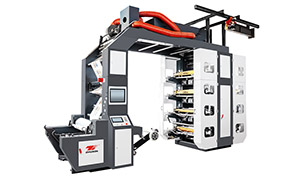
High Speed Flexo Printing Machine - Stack Flexo Flexo Printing Machine
Drying profile optimization: A typical profile consists of a first zone with moderate temperature (60-80°C) and high air velocity to evaporate surface water without boiling, and a second zone with higher temperature (80-110°C) to remove absorbed moisture. The total drying time is determined by the ink coverage and paper weight. For heavy coverage, multiple passes or slower speed may be needed. The dryer exhaust must be controlled to maintain humidity; if the exhaust is too dry, it can suck moisture from the paper, increasing shrinkage.
Moisture re-conditioning: After drying, the paper may be too dry (moisture content <4%), making it brittle. A moisturizing unit (water spray or steam) can be placed after the dryer to re-introduce moisture to the paper's equilibrium level (5-6%). This reduces curling and improves stackability. The amount of moisture added is controlled by a moisture sensor.
Set-off prevention: Set-off occurs when the wet ink transfers to the back of the next layer in the rewound roll. To prevent, the ink must be dried to a touch-dry state before rewinding. The use of anti-set-off powder (spray starch) is common in sheet-fed, but in roll-fed, the drying must be complete. The rewind tension should be low to minimize pressure between layers.
Paper surface and sizing: The paper's surface sizing (internal and surface) affects ink absorption. Highly sized paper (e.g., coated) absorbs less water, so more water must be evaporated; drying is more critical. For uncoated paper, rapid absorption helps but may cause fiber raising (fuzz). A primer or surface coating can be applied to improve print quality and reduce water absorption.
Troubleshooting: Cockling is reduced by adjusting the drying profile (lower temperature, longer time), and by using a moisturizing unit. Set-off is solved by increasing drying power or reducing press speed. Curling is corrected by re-moisturizing and by ensuring the rewind tension is low. By carefully managing the water balance,
flexo printing on paper achieves high quality with minimal defects.