Flexo Printing on Nonwoven: Adhesion and Ink Penetration Management for Porous Fabrics
Nonwoven fabrics, used in diapers, wipes, medical gowns, and filtration, are porous, fibrous structures with variable composition (polypropylene, polyester, or cellulose blends). Flexo printing on nonwoven presents challenges of ink penetration, adhesion to synthetic fibers, and achieving rub resistance without stiffening the fabric. This article provides strategies for successful printing.
The porosity of nonwoven allows ink to penetrate into the fiber matrix. This can be beneficial for fast drying (water-based inks) as the water is absorbed, but it also reduces color density and may cause strike-through. The penetration depth depends on the fiber diameter, web density, and ink viscosity. For high-density nonwoven (e.g., spunbonded PP), penetration is limited; for low-density (e.g., carded web), it is deeper. The ink must have high solids content and a viscosity that balances between surface coverage and penetration.
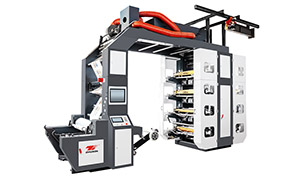
High Speed Flexo Printing Machine - Stack Flexo Flexo Printing Machine
Adhesion to synthetic fibers (PP, PET) is a major challenge because they are non-polar. Corona or plasma treatment is often applied to the nonwoven web before printing to increase surface energy. The ink resin must be compatible; for PP, chlorinated polyolefin or specific acrylic emulsions are used. For water-based inks, a binder (e.g., self-crosslinking acrylic) is essential to lock the pigment to the fiber surface. The binder must be flexible to maintain fabric drape and not stiffen the material.
Rub resistance: Nonwoven products are often abraded during use (e.g., wipes, diapers). The ink film must withstand rubbing without smearing. This is achieved by the crosslinking of the binder during drying, often with a heat-activated crosslinker. The drying temperature must be high enough to activate crosslinking but not melt the synthetic fibers (melting point of PP ≈ 160°C). Typically, drying at 120-150°C for a few seconds is sufficient.
Drying and curing: Water-based inks dry by evaporation and absorption. The dryer should have good air flow and moderate temperature. For heat-set crosslinking, the web must be held at the activation temperature for a sufficient duration. Some nonwovens are sensitive to heat; a hot air oven with precise temperature control is used. UV inks are less common due to the high cost and need for flexible inks, but UV-LED can be used if the formulation is flexible.
Printing equipment: Nonwoven printing often uses a stack press with low impression to avoid crushing the fiber structure. The anilox is selected for the desired coverage; a moderate volume (5-8 bcm) with medium line screen (400-600 lpi) is typical. The web tension must be low to prevent stretching and distortion.
Quality control: Color density, rub resistance (by crockmeter), and absorbency (oil and water) are tested. The ink must not inhibit the fluid absorbency of the nonwoven (for hygiene products). A water droplet test ensures that the printed area still absorbs liquid. By controlling penetration, adhesion, and drying,
flexo printing on nonwoven produces durable, functional prints that meet the stringent requirements of medical and hygiene industries.