Flexo Printing on Film: Specialized Tension and Register Control for Extensible Substrates
Printing on plastic films (PE, PP, PET, OPS) presents unique challenges due to their low elastic modulus and high extensibility. Even small tension variations cause significant stretch, altering the repeat length and registration. This article provides advanced techniques for tension and register control specifically for film printing.
The key is to minimize tension variations. The unwind tension should be low (0.2-0.5 N/cm width) to avoid stretching, but sufficient to prevent wrinkling. A dancer roller with low inertia and an air cylinder provides a buffer. The tension is controlled by a PID loop that adjusts the unwind motor torque. The web path should have minimal rollers to reduce friction and drag. The use of low-inertia, precision-ground rollers with air bearings is common for film lines.
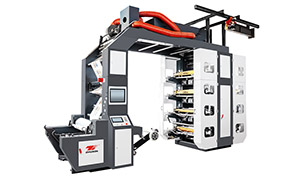
High Speed Flexo Printing Machine - Stack Flexo Flexo Printing Machine
Stretch compensation: The press control system must account for the film's elastic elongation. As the film travels through the press, it may stretch due to the pull of the printing decks and dryers. The stretch varies with speed and temperature. The register control system uses a feedforward model: based on the film's elastic modulus (stored in the database), the system predicts the stretch for a given tension and speed, and pre-adjusts the plate cylinder phase. A closed-loop correction based on mark sensors then fine-tunes the phase. For long runs, an adaptive algorithm updates the stretch factor based on observed register drift.
Temperature control: Films are heat-sensitive; excessive dryer temperature can cause shrinkage or melting. The drying system must use low temperature with high air velocity to compensate. For UV, LED curing is preferred as it adds minimal heat. The central drum in CI presses is water-cooled to maintain a constant temperature, preventing thermal expansion that would change the drum diameter and thus the repeat length.
Handling static: Films generate static electricity, attracting dust and causing shocks. Ionizing bars are placed at multiple points to neutralize static. The press should be grounded, and the substrate should be cleaned with a tacky roller before printing.
Register maintenance: Because films stretch, the register between colors can drift. The register control system must have a high bandwidth (update rate > 100 Hz) to correct stretch variations. Predictive algorithms that anticipate stretch based on the rate of tension change are more effective than reactive PID. Some presses use a "stretch sensor" – a pair of encoders that measure the film's elongation directly – to provide a real-time stretch signal for feedforward compensation.
Best practices: Use lower impression pressure to avoid deforming the film. Keep the web path as short as possible to minimize stretching. Use sleeve technology for quick plate changes, as it allows fine adjustment of repeat length. Regularly check the film's elastic modulus as it can vary between batches; adjust the compensation model accordingly. By mastering these film-specific controls, flexo printers achieve high-quality output on films with minimal waste and register errors.