Flexo Printing on Film: Ink Selection and Curing Strategy for Different Film Chemistries
The chemistry of the film substrate determines the appropriate ink system and surface treatment. Polyolefins (PE, PP) are non-polar and require corona treatment and specific resin binders. Polyester (PET) is slightly polar and easier to print on. PVC and OPS are polar but heat-sensitive. This article provides a guide to ink selection and curing for different films.
For PE and PP, corona treatment (or flame treatment) is mandatory to achieve surface energy >38 dynes/cm. The ink resin must be compatible; polyamide and nitrocellulose-based inks are common for solvent systems, while acrylic emulsions are used for water-based. For UV, formulations with high polarity and adhesion promoters are used. A primer (chlorinated polyolefin) can be applied before printing for maximum adhesion, especially on untreated or low-dyne films. The ink must have excellent flexibility to avoid cracking during bag-making or film stretching.
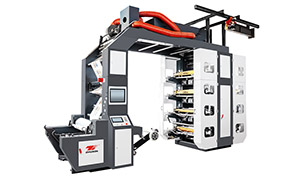
High Speed Flexo Printing Machine - Stack Flexo Flexo Printing Machine
For PET, the surface energy is naturally higher (38-42 dynes/cm), so corona treatment is often sufficient. PET is used for high-barrier packaging and labels. UV inks with high crosslink density provide good adhesion and chemical resistance. Solvent-based polyurethane inks are also common due to their excellent adhesion and heat resistance. Water-based inks on PET require specific acrylic resins and are less common.
For PVC and OPS (shrink films), heat sensitivity is a major concern. The drying/curing temperature must be low (below 60°C). UV LED is ideal because it generates minimal heat. The ink must also have good flexibility to withstand shrinkage without cracking; the crosslink density should be controlled (not too high). Solvent-based inks for PVC often use ketone or ester solvents that swell the film, enhancing adhesion but also causing risk of distortion.
Ink migration for food packaging: For films used in direct food contact, the ink must be low-migration; i.e., the components (pigments, photoinitiators) must not migrate through the film into the food. The ink is often applied on the outer layer, but if the film is thin, migration risk exists. Low-migration UV inks (with specific PIs) and solvent-based inks with high molecular weight resins are available. The printed film must be tested for overall migration per FDA or EU regulations.
Curing strategy: For UV, the dose must be sufficient to cure the full film thickness. Pigmented inks (white, black) require higher dose. The use of multiple lamps or high-power LEDs is recommended. For solvent-based, the drying must ensure complete solvent removal; residual solvents can cause odor and migration. The dryer temperature profile should match the film's heat tolerance; for heat-sensitive films, a two-stage drying with lower temperature and high air flow is used.
Testing: Adhesion, rub resistance, and solvent resistance tests are performed on the printed film. For food packaging, migration tests are mandatory. By selecting the right ink and curing strategy for each film chemistry, flexo printers ensure durable, safe, and high-quality printed films that meet industry standards.