Flexo Printing on Board: Ink Penetration and Drying on Porous Board for High-Speed Production
Board substrates (corrugated and paperboard) are highly porous, making water-based inks the standard. The ink's penetration and subsequent drying (evaporation of remaining water and resin coalescence) determine the print quality and production speed. This article explores the interplay between penetration and drying and how to optimize for high-speed runs.
When water-based ink contacts board, the water is rapidly absorbed by the fibers, while pigments and resin remain on the surface. This absorption is the main mechanism for "set-off" – the ink becomes touch-dry within milliseconds, allowing the board to be stacked or rewound quickly. However, the resin film on the surface is still soft; it needs additional drying (evaporation of residual water and coalescence) to become hard and rub-resistant. This secondary drying can be slower, limiting the press speed if not managed.
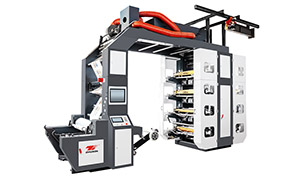
High Speed Flexo Printing Machine - Stack Flexo Flexo Printing Machine
The penetration rate depends on the board's porosity and the ink's viscosity. Low viscosity ink penetrates faster, reducing set-off time, but may cause strike-through (show-through). High viscosity ink stays on the surface, giving better color density and gloss, but requires more evaporative drying. The optimal viscosity is a compromise; it is determined by the board's absorption rate and the required rub resistance. A quick test: apply a drop of ink to the board and measure the time to lose its wet appearance; this gives the absorption time.
Drying systems for board: The main drying is by hot air impingement, which evaporates the remaining water and heats the board to promote resin coalescence. The air temperature is typically 100-150°C for corrugated, but must be controlled to avoid warping. IR dryers can be used as a booster, but they must be placed carefully to prevent scorching. The dryer's efficiency is critical for high speed; for a 200 m/min line with heavy coverage, the dryer may need to be 3-5 meters long.
Water absorption and fiber swelling: As water is absorbed, the board's fibers swell, which can cause dimensional changes (stretch or curl). To minimize, the ink's water content should be as low as possible (high solids). Also, the board should be conditioned to the plant's humidity before printing. A moisturizing section after drying can re-balance moisture and reduce curl.
Rub resistance: After drying, the ink film must have adequate rub resistance to withstand handling. This is achieved by the resin's Tg (glass transition) and the addition of waxes or slip agents. Over-drying can make the film brittle and reduce rub resistance; the drying should be just enough to coalesce the resin. A rub tester (e.g., Sutherland) is used to measure resistance.
Speed optimization: To increase speed without sacrificing quality, the ink's solids content can be increased (reducing water), the dryer temperature can be raised (within limits), or the board can be pre-heated to reduce the drying load. Some converters use a "two-roll" coating system to apply a pre-coat that seals the surface, reducing penetration and allowing faster drying. By understanding and controlling penetration and drying,
flexo printing on board achieves high productivity and quality, meeting the demands of the packaging industry.