Flexo Printing on Board: Impression Pressure Optimization for Fluted Corrugated and Solid Board
Printing on board – whether corrugated (with fluted medium) or solid paperboard – requires careful impression pressure management. Corrugated board has a compressible structure; excessive pressure crushes the flutes, weakening the box. Solid board (folding carton) is stiffer but still sensitive to marking. This article presents methods for optimizing impression pressure for board printing.
For corrugated, the impression cylinder must have a compliant covering (rubber or foam) that conforms to the board's surface, allowing the plate to contact the flute tips and the valleys. The covering hardness (Shore A) is chosen based on the board grade: soft covering (30-40A) for double-wall to minimize crush, harder (50-60A) for single-wall. The impression force is controlled by a hydraulic or pneumatic cylinder that applies a constant force, not a fixed gap. The force is set to achieve good ink transfer without reducing board caliper by more than 5% (measured by a thickness gauge).
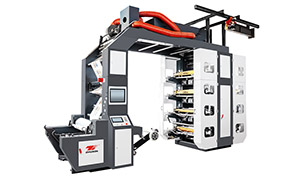
High Speed Flexo Printing Machine - Stack Flexo Flexo Printing Machine
Measuring flute crush: An inline caliper gauge or an offline micrometer is used to measure the board thickness before and after printing. If the thickness reduction exceeds 10%, the board's compression strength (ECT) is compromised. The press's control system can include a caliper sensor that adjusts the impression force in real-time if crush exceeds a threshold. For pre-print on liner, the board is not yet fluted, so crush is not an issue; the impression is similar to film or paper.
For solid board (paperboard, carton stock), the impression is more straightforward but still requires uniform pressure to avoid marking and achieve consistent density. The impression cylinder is typically steel with a smooth surface. The pressure is set to give a slight squeeze (0.1-0.2 mm deflection) to ensure contact. Too high pressure can crease the board; too low gives poor transfer. A pressure indicator (e.g., a pressure strip) is used to check uniformity across the width.
Plate selection for board: For corrugated, the plate should have a deep relief (0.6-1.0 mm) to bridge the flutes, with hard durometer (60-70A) to resist compression. For solid board, a shallower relief (0.3-0.5 mm) and softer plate (40-50A) are acceptable. The plate's dot structure should be designed for the expected dot gain, which is higher on rough board.
Optimization process: A test run with varying impression pressures is performed. The board is printed with a solid patch and a 50% tint. The density and dot gain are measured, and the board thickness is recorded. The optimal pressure is the one that gives acceptable density and gain while minimizing crush. This pressure is stored as a recipe for each board type and press speed.
Troubleshooting: Low density on corrugated suggests insufficient impression or incorrect covering hardness; increase pressure or use softer covering. Flute mark (dark lines where flutes are) indicates uneven pressure or too-high pressure; adjust the covering or reduce force. Board marking (indentations) on solid board is due to high pressure or sharp edges on the impression cylinder; reduce pressure or smooth the cylinder. By optimizing impression pressure,
flexo printing on board achieves sharp, consistent prints while preserving the board's strength.