Flexo Printing Troubleshooting: Real-Time Adaptive Correction Using Inline Sensing and AI
Traditional troubleshooting is reactive – the operator detects a defect and then corrects it. However, modern flexo presses are equipped with inline sensors (cameras, spectrometers, tension sensors) and AI algorithms that can detect and correct deviations in real-time, often before the operator notices. This article explores the architecture and implementation of adaptive correction systems.
The core is a closed-loop control system that continuously monitors key quality indicators: density, dot gain, register, and defect counts. When a deviation exceeds a preset tolerance, the system first checks if it is a transient (noise) or a persistent trend. If persistent, it initiates a corrective action using a pre-trained model. For example, if density drops by 0.1, the system may increase anilox pressure by a small increment and re-measure after a few meters.
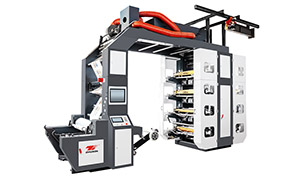
High Speed Flexo Printing Machine - Stack Flexo Flexo Printing Machine
Machine learning models are trained on historical data that links press settings (anilox pressure, impression, dryer temperature, speed) with quality outcomes. The model can predict the optimal adjustment for a given deviation, using a reinforcement learning approach that learns from past successful corrections. The model is hosted on an edge computer and updates in real-time. The system also considers the uncertainty: if the model confidence is low, it alerts the operator instead of acting autonomously.
Implementation requires a robust sensor network. The spectrophotometer provides color data; the line-scan camera detects hickeys, streaks, and register; the tension sensors and encoders provide mechanical data. All data is time-stamped and synchronized. The system uses a sliding window of, say, 10 meters to compute moving averages, reducing false alarms.
One of the key challenges is distinguishing between a systemic drift and a localized defect. For instance, a single hickey may not warrant a press-wide adjustment; the system can flag it for cleaning but not change settings. The AI uses pattern recognition – if hickeys appear frequently, it may suggest cleaning the ink filters or adjusting the doctor blade.
The system also provides "recommended actions" on the HMI, explaining the deviation and the proposed correction. The operator can accept, modify, or reject the action, maintaining human oversight. This human-in-the-loop approach ensures safety and allows the operator to learn from the system's suggestions.
Case study: A converter implemented this system on an 8-color CI press. Within six months, average waste per job dropped from 120 meters to 45 meters, and the number of manual interventions decreased by 70%. The system also captured data that led to a change in the cleaning schedule, reducing anilox wear. The combination of real-time sensing and AI transforms troubleshooting from a reactive chore to a proactive, data-driven optimization process, making it a key differentiator for high-performance flexo operations.