Flexo Printing Production Line: Automation and Digital Integration for Industry 4.0
The modern flexo production line is a cyber-physical system that integrates automation, sensors, and digital communication to form a "smart" line. Industry 4.0 principles are applied to achieve predictive maintenance, real-time quality control, and seamless integration with enterprise systems. This article explores the digital infrastructure and its benefits.
At the machine level, the line is equipped with hundreds of sensors: temperature, vibration, pressure, tension, thickness, color (spectrophotometer), and web inspection cameras. These sensors are connected via fieldbus to a local edge computer, which performs real-time signal processing and control. The edge computer also hosts the PLC logic and the motion control algorithms.
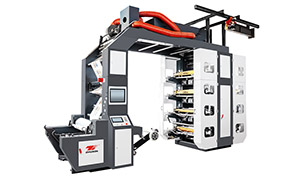
High Speed Flexo Printing Machine - Stack Flexo Flexo Printing Machine
The edge computer is connected to a higher-level system (MES – Manufacturing Execution System) via OPC UA or MQTT. The MES receives production data (speed, waste, quality metrics) and equipment status. It uses this data for scheduling, job management, and tracking of material consumption. The MES also sends job recipes to the line, ensuring that all settings (tension, temperature, register offsets) are automatically loaded when a job is started.
Cloud and remote monitoring: The edge computer sends aggregated data (e.g., daily OEE, defect summaries, alarm logs) to a cloud platform. The cloud analytics use machine learning to detect patterns, such as a correlation between anilox wear and dot gain, or between bearing temperature and speed. Predictive maintenance models are trained on this data; they can predict the remaining useful life of components and schedule maintenance before failure.
Quality management: The inline inspection system (cameras and spectrometers) continuously monitors print quality. It detects defects (streaks, hickeys, misregister) and, using image recognition, classifies them. The system can automatically adjust the press (e.g., increase impression if density drops) or mark the defective area for later removal. The quality data is stored and used for statistical process control (SPC) – control charts are automatically generated, and alarms are triggered if the process goes out of control.
Digital twin: Some advanced lines have a digital twin – a virtual model of the physical line that simulates its behavior. The digital twin is used for off-line testing of new job parameters, operator training, and predictive simulation. For example, if a new substrate is introduced, the digital twin can predict the required tension and dryer settings, reducing setup time.
Connectivity and cybersecurity: The line's network must be secure against cyber threats. Firewalls, VPNs, and role-based access control are implemented. The edge computer has a local copy of the software; if the connection to the cloud is lost, the line continues to operate based on local data.
Operator interface: The HMI (Human-Machine Interface) provides a dashboard that shows all key performance indicators, alarms, and trends. Operators can see the status of each module, the current quality metrics, and the predicted maintenance alerts. The interface is touch-screen and intuitive, reducing training time.
By integrating automation and digital connectivity, flexo production lines achieve higher OEE, lower waste, and faster response to quality issues. This digital transformation is essential for converters to remain competitive in a data-driven manufacturing environment.