Flexo Printing Production Line: Architectural Design and Synchronization of Printing and Converting Modules
A flexo printing production line is an integrated system of modules: unwinds, printing decks, dryers/curing, and converting units (coating, lamination, die-cutting, slitting, rewind). The challenge is to synchronize all modules to operate harmoniously at high speed, with precise register between printing and finishing. This article analyzes the architectural design and synchronization strategies.
The line is typically driven by a master speed reference, often from the main drive roller or the central drum (in CI presses). All servo motors follow this reference, but with adjustable phase offsets for each module. The phase offsets are set based on the mechanical distances between the printing and converting units, and the expected web stretch. For example, the die-cutting unit's phase is offset so that the cut aligns with the printed image, considering the web path length and stretch.
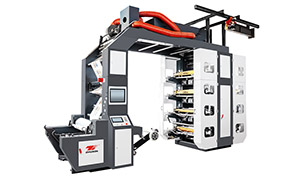
High Speed Flexo Printing Machine - Stack Flexo Flexo Printing Machine
The web path must be designed with minimal length to reduce stretch and registration errors, but with enough space for the required dryers and converting modules. The line is often arranged in a U-shape or L-shape to save floor space. The web tension zones are isolated by dancers between major sections (e.g., between printing and coating, and between coating and die-cutting). Each zone has independent tension control, preventing disturbances from one zone affecting another.
Drive control: Each servo drive has a local PID loop for speed and torque, but the synchronization is governed by a high-level controller that sends the master position reference via a real-time Ethernet (e.g., EtherCAT). The reference is updated every millisecond. The controller also monitors the registration marks and adjusts the phase offsets in closed loop. The phase correction is applied to the relevant module's drive, not the master reference, to maintain overall line speed.
Converting units: Coating and lamination modules require their own tension control for the secondary web (e.g., adhesive film). The secondary web's feed rate must match the primary web's speed, with independent tension control. The laminating nip has a pressure control loop that ensures consistent lamination quality. Die-cutting units have a dedicated mark sensor; the controller adjusts the die's phase relative to the print. Slitting units are simpler: they just have knives positioned to the correct lateral position.
Line speed and productivity: The maximum speed is limited by the slowest module, often the drying or curing unit. The line's control system ensures that if the drying is insufficient, the entire line slows down automatically. The system also manages the start-up and stop sequences to avoid tension shocks: the line accelerates smoothly (e.g., over 30-60 seconds) with pre-programmed ramps for each module.
Maintenance: The line has multiple modules; a modular design allows isolation and maintenance of one module while the others operate (if possible). However, the entire line must be stopped for major maintenance. Regular inspection of the synchronization (via phase measurement) is essential; any drift indicates wear or misalignment.
By designing the line with careful synchronization and tension isolation, flexo production lines achieve efficient one-pass production, reducing handling and labor, and improving overall equipment effectiveness.