Flexo Printing Press Vibration Analysis and Damping for High-Speed Operation
At high speeds (400-600 m/min), vibration becomes a critical factor that limits both print quality and machine longevity. Even sub-micron vibrations at the print nip translate into visible print defects such as banding, ghosting, and gear marks. Understanding the source, transmission, and mitigation of vibrations is essential for designing and operating high-performance
flexo printing presses.
Vibration sources can be broadly classified as internal (mechanical) and external (environmental). Internal sources include gear mesh excitation, bearing defects, unbalanced rotating masses, and the periodic impact of the doctor blade against the anilox roll. The fundamental frequency of gear mesh is the product of the number of teeth and the rotational speed; for a 60-tooth gear at 300 rpm, the mesh frequency is 300 Hz – within the audible range and often the primary cause of gear marks on the print. Other internal sources: roller run-out due to manufacturing tolerances, and the impulse from the splicing process when the web is joined.
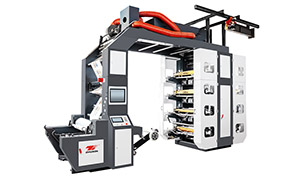
High Speed Flexo Printing Machine - Stack Flexo Flexo Printing Machine
External sources: floor vibrations from nearby machinery, air turbulence from drying fans, and even acoustic feedback from the press room. These are often transmitted through the press frame and foundations. To isolate external vibration, presses are mounted on anti-vibration pads or inertia blocks (massive concrete foundations). Some presses use active vibration canceling systems with accelerometers and piezoelectric actuators that generate counteracting forces.
Modal analysis is the standard engineering tool to characterize the press's vibration modes. By impacting the structure with a calibrated hammer and measuring the response with accelerometers, the natural frequencies and mode shapes are determined. For a typical press frame, the first natural frequency may be around 50-80 Hz. If any excitation frequency coincides with a natural frequency, resonance occurs, amplifying the vibration amplitude dramatically. The press designer must ensure that the critical excitation frequencies (gear mesh, roller rotation) are at least 20% away from any natural frequency – achieved by stiffening the frame, adding mass, or changing gear tooth counts.
Damping solutions: Structural damping is enhanced by using materials with high internal friction (e.g., polymer concrete for the frame, or sandwich constructions with viscoelastic layers). Bearings with preload reduce clearance-induced backlash. Gearboxes with helical gears (as opposed to spur gears) reduce the abruptness of tooth engagement, smoothing the excitation. Some presses use elastomeric couplings between motors and cylinders to absorb torsional vibrations. The doctor blade system, a common vibration source due to blade chatter, is designed with a tuned mass damper or a compliant blade holder that shifts its natural frequency away from the operating range.
Vibration monitoring: On-line accelerometers continuously measure vibration levels at key locations (bearings, frame, anilox mounts). The Fast Fourier Transform (FFT) of the signal shows the frequency spectrum; any change in the amplitude at specific frequencies indicates developing faults (e.g., bearing wear shows peaks at the ball pass frequency). The control system can alert the operator or automatically reduce speed if vibration exceeds a threshold to prevent catastrophic failure and print defects. Some systems also use the vibration signature to optimize press settings – for example, adjusting the impression pressure to reduce the vibration-induced dot gain.
Impact on print quality: Vibration at the nip causes relative motion between the plate and substrate, leading to blurred edges, misregister, and "banding" (periodic density variations). The most sensitive are fine highlights and screens; a 5-micron vibration can reduce the practical resolution by 10 lpi. Vibration also accelerates plate and anilox wear, increasing operating costs. At high speeds, the dynamic forces increase quadratically; thus, a 50% speed increase quadruples the centrifugal forces, making vibration control even more critical.
Remedial actions for existing presses: Rebalancing of rotating components, replacing worn gears, upgrading to helical gears, and adding structural bracing. Also, the press speed can be adjusted to avoid known resonant speeds – some presses have a "vibration map" that identifies safe speed zones. In extreme cases, dynamic absorbers (tuned mass dampers) are attached to specific locations to cancel out a troublesome frequency. The combination of robust design, active monitoring, and predictive maintenance ensures that high-speed flexo presses can achieve excellent print quality with minimal vibration-induced defects, pushing the boundaries of productivity.