Flexo Printing Press Thermal Management: Heat Generation, Dissipation, and Stability
The flexo printing press generates significant heat from various sources: friction in bearings and gears, motor losses, drying/curing energy absorbed by the web and cylinders, and ambient environmental changes. Thermal management is crucial because even small temperature variations cause expansion of metal components, altering cylinder diameters, gear pitch, and web tension, which manifest as register drift, repeat length variation, and color shifts. This article delves into the thermal behavior of flexo presses and the engineering strategies to mitigate its effects.
Primary heat sources: The largest contributor is the drying system – hot air at 60-150°C impinging on the web transfers heat to the impression cylinder and surrounding structure by convection and radiation. For CI presses, the central drum acts as a heat sink; its large mass absorbs heat, but uneven heating across its width can cause bowing (thermal camber). Motor drives and gearboxes add thermal loads through electrical losses and friction, raising the temperature of the frame and bearings. Additionally, the anilox and plate cylinders experience frictional heating at the nip.
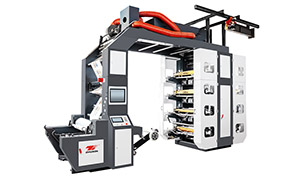
High Speed Flexo Printing Machine - Stack Flexo Flexo Printing Machine
Thermal expansion coefficients: Steel has a coefficient of 12×10^-6 /°C; a 1-meter diameter cylinder with a 20°C temperature rise expands by 0.24 mm in circumference, which corresponds to a repeat length change of about 0.08% – a significant error for tight register. To combat this, precision presses incorporate active cooling: water channels drilled inside the central drum of CI presses circulate temperature-controlled coolant (typically at 25-35°C) to maintain the drum's outer surface within ±1°C across the width and over time. This is often augmented by temperature sensors embedded in the drum surface, feeding back to a chiller unit that adjusts coolant flow.
Cooling strategies for other components: Plate cylinders and anilox rollers may have internal cooling passages, but many presses rely on passive cooling through large thermal masses and natural convection. In stack presses, each impression cylinder may be cooled separately, but the longer web path means the web carries heat from one deck to the next, accumulating temperature. This can cause a gradient – the first deck runs cooler than the last – leading to register errors. To compensate, some presses use variable plate cylinder speeds or thermal compensation algorithms that predict the thermal growth based on the press speed and drying settings, and apply an electronic correction (micro-adjusting the motor phase) to nullify the effect.
Thermal modeling and simulation: Engineers use finite element analysis (FEA) to simulate the press's thermal response under various operating conditions. The model includes heat transfer coefficients for forced convection from air impingement, conduction through cylinder walls, and radiation. The simulation predicts the temperature distribution and the resulting deflection. Based on this, the press design can incorporate features like thermal expansion joints or pre-stressed components that counteract expansion.
Practical thermal management in operation: Press manufacturers provide guidelines for warm-up procedures – typically running the press at a slow speed with all heaters and chillers on for 30-60 minutes to reach thermal equilibrium before production. This ensures that all components are at their operating temperature, so subsequent thermal changes are minimal. Additionally, the press's register control system can be programmed with "thermal drift compensation" – a database of correction factors as a function of press speed and dryer temperature, derived from empirical testing.
Monitoring and diagnostics: Thermal cameras or arrays of thermocouples are used to monitor key points (bearings, cylinder surfaces, frame). Any abnormal temperature rise can indicate lubrication failure, bearing wear, or cooling system malfunction. The control system can trigger alarms or automatically reduce speed to prevent damage. In some advanced presses, a thermal management module continuously adjusts coolant temperature and flow based on real-time thermal feedback, maintaining stability even during speed changes or different ink coverages.
Material selection: Beyond steel, some press components use materials with lower thermal expansion, like Invar (1.5×10^-6 /°C) for critical shafts, but cost and weight are prohibitive. Instead, engineering solutions like dual-material cylinders (steel core with a ceramic or composite sleeve) are emerging, where the sleeve's thermal expansion is matched to the substrate's stretch characteristics. Overall, mastering thermal effects is a hallmark of high-end flexo press engineering, enabling consistent repeat length and register performance across long runs and varying environmental conditions.