Flexo Printing Machine Process Optimization: Drying, Cure, and Web Stabilization
The printing process on a flexo machine is not merely about transferring ink; it is a thermophysical interaction involving heat transfer, mass diffusion, and fluid dynamics. The drying and curing stages are the most energy-intensive and process-sensitive parts of the operation, directly impacting web temperature, solvent evaporation rate, and ultimately the final film properties. An optimized process requires a deep understanding of the drying tunnel's air impingement, the curing unit's spectral output, and the substrate's thermal response.
In water-based ink drying, the evaporation rate is governed by the air velocity, temperature, and the partial pressure of water vapor in the boundary layer. The drying tunnel's nozzle design creates impingement jets that disrupt the boundary layer, enhancing mass transfer. The heat transfer coefficient (typically 50-150 W/m²·K) is a function of nozzle geometry and Reynolds number. The drying capacity must match the ink's water content (typically 30-60% of ink weight). For a 50 gsm wet ink film, evaporating 25 gsm of water requires approximately 60 kJ per square meter – this energy must be supplied by hot air without raising substrate temperature beyond its glass transition (e.g., 70°C for PET film).
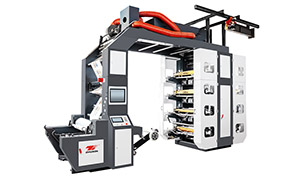
High Speed Flexo Printing Machine - Stack Flexo Flexo Printing Machine
Web stabilization during drying is critical; high-velocity air can cause web flutter, leading to misregister or creases. To mitigate, the drying tunnel incorporates hold-down rollers or air bars that apply a slight vacuum or pressure to keep the web flat. The air flow pattern is designed with a Coanda effect to reduce turbulence. In multi-deck presses, interstation dryers are placed immediately after each color, but the cumulative heat input can raise the substrate temperature progressively; cooling zones or chill rollers are inserted after drying to reset the web temperature before the next color.
For UV curing, the process is photochemical and depends on the spectral irradiance (mW/cm²) and the photoinitiator's quantum yield. The curing depth is limited by the Beer-Lambert law – high pigment loading absorbs UV, reducing cure at the film-substrate interface. To ensure through-cure, the UV lamp's power density (typically 100-200 W/cm) and the number of lamps (2-3 in tandem) are selected. The total energy dose (J/cm²) must be sufficient to achieve a degree of conversion above 90%, measured by differential scanning calorimetry or FTIR. Under-cure leads to tackiness and poor scratch resistance; over-cure can cause film embrittlement and yellowing.
Process integration: The press control system manages the drying and curing parameters in relation to line speed and ink coverage. For instance, when the press accelerates, the air temperature and fan speed are ramped up simultaneously to maintain constant drying efficiency. This is achieved through a feedforward-plus-PID scheme that uses a speed-dependent profile. Similarly, UV lamp intensity is adjusted via dimming or by changing the number of lamps active; LED systems offer instant power adjustment. Real-time sensors (IR web temperature sensors, moisture meters) provide feedback to the control loop.
Quality defects originating from process misoptimization: "Drying mottle" occurs when uneven heat distribution causes differential water evaporation, leaving a pattern; solved by improving nozzle uniformity. "UV shadow" occurs when thick ink layers block UV penetration, resulting in a liquid layer beneath the cured skin; using high-intensity lamps or multiple wavelengths helps. "Web distortion" due to over-drying is reduced by using a two-stage drying approach: first a gentle pre-dry, then a high-velocity final dry. Also, the exhaust air management must balance solvent concentration below the lower explosive limit; continuous LEL monitoring with dilution air or solvent recovery is mandated for solvent-based inks.
Advanced process control now incorporates machine learning models that predict drying outcomes based on incoming substrate parameters (e.g., moisture content, caliper) and adjust settings proactively. These models are trained on historical production data, enabling optimal energy usage and minimal waste. The integration of drying and curing with the rest of the press is a hallmark of high-end flexo machines, transforming them from mere printing devices into intelligent process platforms that deliver consistent, sustainable, and profitable production.