Flexo Printing Machine Price: Total Cost of Ownership Analysis for Long-Term Investment
While the purchase price is the upfront cost, the total cost of ownership over the machine's life (typically 10-15 years) can be several times the initial price. A TCO analysis is essential for a sound investment decision, as it reveals the true cost of each machine option.
TCO components: 1) Initial investment (price + installation + training). 2) Energy costs – electricity for motors, dryers, and UV; gas for hot air. For a typical mid-web press, energy costs can be $50,000-$150,000 per year depending on drying. 3) Consumables – anilox rollers (need replacement every 2-5 years), doctor blades (weekly), plates (per job), inks, and solvents. These can be a significant ongoing cost. 4) Maintenance – spare parts, service contracts, and labor. 5) Operator training and labor costs. 6) End-of-life salvage value (resale or scrap).
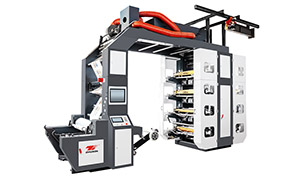
High Speed Flexo Printing Machine - Stack Flexo Flexo Printing Machine
Energy efficiency comparison: A press with LED curing consumes 60% less electricity than mercury lamps, saving $20,000-$40,000 annually. A press with heat recovery on dryers reduces gas consumption by 30-40%, saving $10,000-$30,000. Over 10 years, these savings can equal the price difference between a standard and an energy-efficient press.
Consumables cost: The anilox rollers are a major cost; higher quality (ceramic with longer life) may cost more upfront but last longer. Similarly, doctor blade life varies; choosing a press with a closed chamber that reduces blade wear can save. Ink waste can be minimized by automated viscosity control and quick changeover; a press with auto-wash reduces ink and solvent consumption.
Maintenance cost: A press with easy access to components and modular design reduces maintenance labor and downtime. Predictive maintenance (vibration sensors) can prevent catastrophic failures and reduce repair costs. A service contract from the manufacturer may be cost-effective if it includes priority support and spare parts discount.
Labor savings: Automation reduces operator requirements. A fully automatic press may need only one operator per shift vs. two for a manual press. Over 10 years, labor savings can be $1-2 million, easily justifying the higher automation cost.
Resale value: Brand reputation and condition affect resale. European presses retain value better than lower-cost brands. A press with modern features (LED, servo, automation) will have higher resale value. This should be included in the TCO as a positive terminal value.
TCO calculation method: Sum all costs over the machine's life, discounted to present value (using the cost of capital). Compare TCO per square meter printed. The machine with lower TCO is the better investment, even if its purchase price is higher. For example, Press A costs $2.5 million with TCO of $5.5 million over 10 years; Press B costs $2.0 million with TCO of $6.0 million – Press A is better. By performing TCO analysis, converters can choose the most cost-effective flexo printing machine for their production environment.