Flexo Printing Equipment Dynamics: Roller Geometry and Surface Engineering for Optimal Transfer
Flexo printing equipment comprises a complex system of rollers, each with specific geometric and surface properties that collectively determine the quality of ink transfer. The anilox roller, the plate cylinder, and the impression cylinder are the three primary rollers, and their surface engineering is critical for controlling ink film thickness, release characteristics, and durability. This article examines the materials science and manufacturing processes behind these rollers.
The anilox roller is the most critical metering element. It consists of a steel base, often with a nickel or copper underlayer, and a ceramic topcoat applied by plasma spraying or HVOF (high-velocity oxygen fuel). The ceramic is typically chromium oxide or aluminum-titanium oxide, with a hardness of 1200-1400 HV. The engraved cells are formed by a laser or mechanical engraving process, creating a deterministic pattern. The cell geometry – depth, opening, wall angle – determines the volume. The ceramic's porosity must be minimal to prevent ink entrapment. After engraving, the roller may be coated with a thin diamond-like carbon (DLC) layer for reduced friction and improved release.
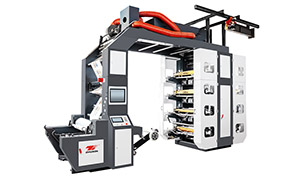
High Speed Flexo Printing Machine - Stack Flexo Flexo Printing Machine
Plate cylinder surface: It must provide a secure grip for the printing plate or sleeve. The surface is usually a chrome-plated steel with a fine shot-blast or circumferential groove pattern to enhance adhesion. For sleeve systems, the mandrel is machined to high precision with an air channel; the sleeve's inner layer is a compressible polymer that expands when air is applied. The surface roughness of the cylinder (Ra 0.8-1.2 µm) is optimized to prevent sleeve slip while allowing easy removal.
Impression cylinder: This roller backs the substrate and must have a smooth, wear-resistant surface to avoid marking the substrate. It is often made of hardened steel (60-65 HRC) with a ground and polished finish (Ra 0.2-0.4 µm). For corrugated applications, the impression cylinder may have a thicker coating, such as tungsten carbide, to resist abrasion from the board. The cylinder's concentricity is maintained by precision bearings and regular grinding.
Roller coating and release properties: The surface energy of the anilox (approx. 40-50 mN/m) and the plate (approx. 30-35 mN/m) determine the ink split ratio. A high surface energy anilox holds the ink, while the lower-energy plate picks it up; this is the key to efficient transfer. Any contamination (oil, dried ink) alters these energies, causing transfer issues. Regular cleaning with ceramic-safe cleaners (pH-neutral) restores the surface energy. Some anilox rollers have an anti-stick coating to improve release, reducing the need for high doctor blade pressure.
Manufacturing tolerances: All rollers must be manufactured with extreme precision. The run-out (TIR) for anilox and plate cylinders is typically <0.005 mm; for impression cylinders, <0.01 mm. The rollers are ground on CNC cylindrical grinders with in-process gauging. After coating, the roller is measured with a coordinate measuring machine (CMM) to verify dimensions. The anilox cell depth and volume are measured using a profilometer and a dedicated cell-volume analyzer; any deviation from the specification is rejected.
Maintenance and reconditioning: Anilox rollers wear over time; the ceramic may crack or the cells become clogged with dried ink. Ultrasonic cleaning and chemical stripping can restore many rollers, but if the ceramic is damaged, the roller must be stripped and re-coated, which is a specialized process. Plate cylinders may need re-chroming if the surface becomes rough. Impression cylinders can be re-ground to remove scratches, but this reduces diameter; shims are then needed to restore the nip geometry.
The engineering of roller surfaces is a blend of materials science, precision machining, and tribology. Properly designed and maintained rollers ensure consistent ink metering, minimal wear, and long service life, which are essential for the economic viability of
flexo printing equipment. As new coatings (e.g., nano-ceramics) and engraving technologies (laser with variable pulse) emerge, the performance boundaries of flexo rollers continue to expand, enabling higher quality and speed.