Flexo Printing Equipment Automation Integration: IIoT, Data Analytics, and Predictive Maintenance
Modern flexo printing equipment is evolving from a collection of mechanical components into a smart, connected system that leverages the Industrial Internet of Things (IIoT), data analytics, and machine learning. This transformation enables predictive maintenance, real-time quality optimization, and remote diagnostics, significantly improving overall equipment effectiveness (OEE). This article explores the technical infrastructure and applications of automation integration in flexo equipment.
The foundation is a network of sensors embedded throughout the press: accelerometers on bearings, thermocouples on cylinders, pressure transducers in hydraulic systems, current sensors on motors, and optical sensors for web inspection. These sensors communicate via industrial Ethernet (e.g., PROFINET, EtherNet/IP) to a local edge gateway that performs preliminary data processing (filtering, normalization). The gateway runs a real-time operating system with deterministic timing to ensure that safety-related data is handled correctly.
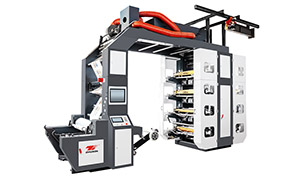
High Speed Flexo Printing Machine - Stack Flexo Flexo Printing Machine
Data analytics at the edge: The edge device executes algorithms for vibration analysis (FFT to detect bearing faults), temperature trend monitoring (to predict overheating), and motor current signature analysis (to detect load imbalances). When a parameter exceeds a pre-set threshold, the system generates a warning. More advanced edge analytics use anomaly detection models (e.g., autoencoders) trained on historical data to identify subtle deviations that may indicate incipient faults. These models are updated periodically with new data from the cloud.
Cloud integration and remote monitoring: The edge gateway sends aggregated data (e.g., daily summaries, alerts) to a cloud platform where it is combined with data from other presses in the same plant or across multiple plants. The cloud analytics use machine learning to correlate faults with operational conditions, such as substrate type or speed, and to recommend optimal maintenance schedules. For instance, the system may learn that a particular bearing fails after 2000 hours at a certain speed, and thus schedule replacement at 1800 hours. Remote experts can access the press data for troubleshooting, reducing the need for on-site visits.
Predictive maintenance implementation: A typical predictive maintenance model uses a random forest or gradient boosting algorithm, trained on labeled data (fault vs. normal). Inputs include vibration spectral features, temperature, speed, and production counters. The model outputs a remaining useful life (RUL) estimate, which is displayed on the HMI. The maintenance team receives a report with recommended actions. This approach has been shown to reduce unplanned downtime by 30-50% and extend bearing life by 10-20% through timely lubrication or load reduction.
Quality optimization: The data from the press's inline spectrophotometer and web inspection cameras is also streamed to the analytics system. The system correlates print defects (e.g., streaks, color deviation) with press parameters (e.g., doctor blade age, anilox pressure) to identify root causes. This information is used to create "control rules" – if the trend indicates increasing streaks, the system may automatically increase doctor blade pressure slightly or alert the operator to replace the blade. Over time, the system builds a knowledge base that enables rapid diagnosis of quality issues, reducing waste and rework.
Cybersecurity and data integrity: With increased connectivity, cybersecurity becomes paramount. Presses are equipped with firewalls, VPNs, and secure authentication. Data encryption is used for remote communication. The control system also has fail-safe mechanisms: if the network connection is lost, the press continues to operate based on the last validated settings, and all local data is buffered to be transmitted later.
Implementation challenges: Retrofitting older presses with sensors can be costly; new presses are increasingly shipped with IIoT-ready hardware. The data volume can be high, requiring efficient compression and storage. Additionally, the analytics models require a substantial amount of historical data to be accurate; this is often collected during the first year of operation.
The integration of IIoT and predictive analytics is transforming
flexo printing equipment from a reactive maintenance paradigm to a proactive, data-driven approach. This not only improves uptime and quality but also enables remote support, faster troubleshooting, and continuous process improvement, positioning flexo printing as a modern, smart manufacturing technology.