Flexo Printing Defects: Microscale Analysis and Prevention through Statistical Process Control
While visual identification is the first line of defense, advanced defect prevention relies on microscale analysis and statistical process control (SPC). By monitoring process parameters at a microscopic level, converters can detect trends that lead to defects before they appear, enabling proactive maintenance and adjustment.
Microscale analysis involves examining the printed dots and ink film under high magnification (100-1000x). Key indicators: dot shape (round vs. oval), dot edge roughness (fringe), and cell structure of the anilox (to check for wear). A well-formed dot is round with smooth edges; any distortion suggests mechanical or pressure issues. The ink film thickness can be measured using a profilometer; deviations from target indicate anilox or transfer problems. This analysis is typically done offline on sample prints, but inline microscopes are emerging.
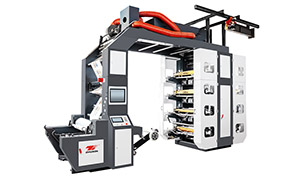
High Speed Flexo Printing Machine - Stack Flexo Flexo Printing Machine
Statistical process control (SPC) applies statistical methods to monitor process parameters. For flexo, key parameters include: density (mean and standard deviation), dot gain (50% tone), register error, and defect counts per 1000 meters. Control charts (e.g., X-bar and R charts) are used to track these over time. The process is stable when all points are within control limits and there are no systematic patterns (e.g., runs above or below average). When a control chart shows a trend (e.g., density gradually decreasing), it signals an approaching out-of-control condition, allowing preventive action before a defect occurs.
Process capability indices (Cp, Cpk) measure how well the process meets specifications. For example, if the specification for density is 1.4 ± 0.05, and the process has a standard deviation of 0.01, Cpk is high (indicating good capability). If Cpk drops below 1.33, the process needs improvement – possibly by reducing variation through better anilox maintenance or temperature control.
Implementation requires data collection from inline sensors and a dedicated SPC software. The system automatically updates control charts and sends alerts when a parameter approaches the control limit. Operators are trained to interpret the charts and take corrective actions based on the pattern – for instance, a gradual increase in dot gain may require impression adjustment, while a sudden spike suggests plate damage.
Prevention of catastrophic defects: By monitoring the rate of hickeys per meter, the system can predict when the anilox needs cleaning. If the rate exceeds a threshold, it schedules cleaning during the next job change. This predictive approach reduces unplanned downtime and waste.
Case study: A label converter implemented SPC for dot gain and density. Within three months, they reduced the standard deviation of dot gain from 2.5% to 1.2%, and the defect rate (rejects per million) dropped from 5000 to 800. The system also identified that a specific anilox roller had a wear rate 30% faster than others, leading to a change in supplier. By combining microscale analysis with SPC, flexo printers can achieve defect-free operation, enhancing customer satisfaction and profitability.