Flexo Printing Defects: Comprehensive Classification and Visual Identification Guide
Flexo printing defects manifest in numerous forms, each with distinct visual characteristics that point to specific root causes. A standardized classification system enables operators to quickly identify defects and initiate corrective measures. This article provides a comprehensive taxonomy of common defects with visual descriptors.
Defects are categorized into four main groups: (1) Transfer-related defects – issues with ink film uniformity and completeness. (2) Registration defects – misalignment of colors. (3) Mechanical defects – patterns caused by roller imperfections or drive irregularities. (4) Substrate defects – wrinkles, tears, or distortions originating from the web.
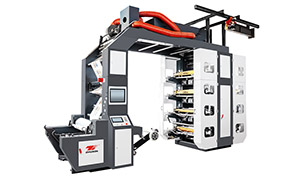
High Speed Flexo Printing Machine - Stack Flexo Flexo Printing Machine
Transfer defects: Hickeys – small, irregular white or colored spots due to particles on the plate or anilox; appear as a halo if a particle is on the impression cylinder. Pinholes – tiny voids in the ink film, caused by low viscosity, poor wetting, or dust; often visible as light dots in solids. Mottle – uneven, patchy density in solids, originating from non-uniform anilox transfer or substrate roughness; appears as a cloudy pattern. Orange peel – a textured, bumpy surface in solids, caused by ink levelling issues or incorrect anilox; resembles citrus peel texture. Streaks – linear discolorations along the web direction, from doctor blade nicks, anilox scratches, or ink starvation; can be light or dark depending on the cause. Gear marks – repeating bands across the web at the gear tooth frequency, indicating gear wear or backlash.
Registration defects: Misregister – color-to-color offset, either circumferential (leading/trailing) or lateral; visible as color fringes or double images. Repeat length error – the printed pattern length deviates from the target, causing mismatch with subsequent converting; measurable as drift in mark spacing.
Mechanical defects: Barring – cyclic density variation across the web, often from cylinder run-out or bearing play; appears as faint horizontal bands. Ghosting – faint duplicate images, caused by ink transferring to a roller and later back to the web; often from incomplete drying or contaminated impression cylinder.
Substrate defects: Wrinkles – creases in the web, resulting from uneven tension or misaligned rollers; visible as folded lines that interrupt printing. Tearing – web breaks or edge tears, from excessive tension or damage. Fluting – waviness in paperboard after drying, from moisture loss.
Visual identification guide: For each defect, a reference library of photos and descriptions is provided to operators. They are trained to use a magnifying glass or a portable microscope to examine the defect's characteristics. For example, hickeys can be distinguished from pinholes by their irregular shape and the presence of a dark center (the particle). Mottle can be differentiated from orange peel by the scale of the unevenness – mottle is larger (cm-scale), orange peel is finer (mm-scale).
Corrective actions are mapped to each defect type. The guide includes a decision tree: "If defect looks like X, check Y and adjust Z." This reduces diagnostic time and ensures consistent responses across shifts. By using a systematic classification and visual identification, converters can achieve faster resolution and lower waste, improving overall quality performance.