Flexo Printing Accuracy: Dimensional Stability and Compensation for Substrate Stretch and Shrinkage
Dimensional accuracy in flexo printing refers to the consistency of the print repeat length (the distance between identical printed elements) and the lateral dimensions. Substrates stretch under tension, shrink when dried, and expand with temperature and moisture changes. This article examines the mechanisms of substrate deformation and the compensation techniques used to maintain precision.
Substrate stretch is primarily elastic: when the web is tensioned, it elongates according to Hooke's law: ΔL = (T × L) / (E × A), where T is tension, L is the free length, E is the elastic modulus, and A is cross-sectional area. For films, E is low (e.g., 200-1000 MPa), so stretch can be 1-3% at typical tensions. This stretch changes the repeat length; for a 500 mm repeat, a 1% stretch adds 5 mm, which is unacceptable. To compensate, the plate cylinder circumference is reduced relative to the impression drum circumference, so that when the plate is mounted and stretched, the printed repeat matches the target.
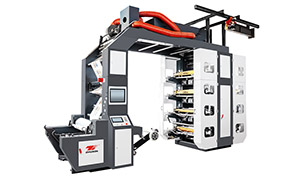
High Speed Flexo Printing Machine - Stack Flexo Flexo Printing Machine
Thermal expansion: When the web is heated in the dryer, it expands; if it is then cooled, it shrinks. For films, thermal expansion coefficient is 50-200 µm/m·°C. A 10°C temperature rise causes 0.05-0.2% length change. The press's cooling section and chill rollers are used to bring the web back to a stable temperature before the next color. However, the temperature may not be uniform; edge vs. center differences cause distortion. Closed-loop temperature control with multiple sensors is required.
Moisture effects on paper and board: Paper expands when it absorbs moisture (hygroscopic expansion) and shrinks when dried. The moisture content changes from the unwind (typically 5-7%) to after drying (2-4%), causing significant shrinkage – up to 0.5% in the machine direction. This shrinkage is non-linear and depends on the drying history. To compensate, some presses use a moisturizing unit (a water spray) after the dryer to re-introduce moisture to a consistent level, minimizing dimensional changes.
Measurement of repeat length: The press control system uses an encoder on the impression cylinder and a mark sensor to measure the actual repeat length continuously. The repeat length is calculated from the distance between successive marks. The system compares it to the target and adjusts the plate cylinder phase (or speed) to correct any deviation. This is a closed-loop repeat control, often integrated with register control.
Pre-distortion of plates: For jobs where the substrate will shrink significantly after printing (e.g., shrink sleeves), the artwork is pre-distorted (stretched or compressed) in the prepress stage so that after shrinkage, the dimensions are correct. The distortion factor is derived from the shrinkage ratio of the sleeve material. The press's repeat length is set to the distorted value, and the control system ensures that the printed repeat matches it.
Tolerance requirements: For most packaging, repeat length tolerance is ±0.2 mm. For intricate label shapes that must match a die-cut, tolerance is ±0.1 mm. Achieving these tolerances requires careful control of tension, temperature, and moisture, as well as precise plate mounting and compensation algorithms.
By implementing comprehensive dimensional control, flexo printers achieve the accuracy needed for high-quality packaging, ensuring that printed patterns align with converting processes (cutting, folding, sealing) without waste.