Flexo Printer Plate Technology: Photopolymer Properties and Relief Optimization
The printing plate is the heart of a
flexo printer, and its material properties, relief structure, and mounting accuracy directly determine the achievable print resolution, dot gain, and tone reproduction. Modern photopolymer plates are sophisticated composite materials optimized for specific ink and substrate combinations, and the plate-making process has evolved from analog to digital with significant quality improvements.
Photopolymer plates consist of a polyester base, a photopolymerizable resin layer, and a protective slip film. Upon UV exposure through a negative (or via digital mask in laser-engraved plates), the exposed areas polymerize and become insoluble, while unexposed areas are washed away to create relief. The relief depth (typically 0.2-0.7 mm for narrow-web, 0.6-1.2 mm for corrugated) is critical: too shallow leads to plate bottoming and excessive dot gain; too deep causes dot tipping and washout artifacts. The optimum depth is determined by the anilox line screen and substrate roughness – rougher substrates need deeper relief to accommodate the substrate texture.
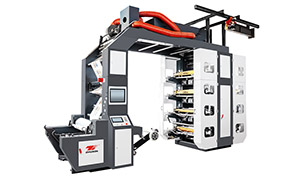
High Speed Flexo Printing Machine - Stack Flexo Flexo Printing Machine
Dot structure is a key quality factor. Traditional round-top dots (from analog or conventional digital plates) produce a "hockey-stick" dot shape with a narrow base, causing dot breakage and high gain. Flat-top dot (FTD) technology, achieved by oxygen inhibition elimination during exposure (e.g., by using a mask film or a nitrogen chamber), produces dots with a flat top and vertical sidewalls. This results in a more stable printing surface, less dot gain (typically 10-15% vs. 20-25% for round-top), and better ink transfer stability across long runs. FTD plates also exhibit improved resolution, allowing for 1-2% highlights to be reliably reproduced.
Plate hardness, measured in Shore A (typically 30-60 for narrow-web, 40-70 for corrugated), influences ink transfer and wear. Softer plates conform better to rough substrates but are more prone to dot squash and wear; harder plates produce sharper dots but require higher impression pressure. The hardness is a trade-off with substrate – films need softer plates (30-40A) to avoid haloing, while board requires harder plates (60-70A) for durability. Recent developments include "dual durometer" plates with a hard base and soft surface, combining durability with conformability.
Plate mounting is a precision operation: the plate must be stretched and adhered to the plate cylinder or sleeve with zero distortion. Mounting tapes with specific adhesive thickness and compressibility (e.g., 0.2-0.5 mm) are used to fine-tune the repeat length. The mounting tape's foam layer provides a cushion that absorbs pressure variations, reducing dot gain. Laser-scored mounting tape ensures accurate angular and lateral positioning. Cylinder or sleeve run-out must be <0.01 mm to avoid positional errors.
Plate wear and longevity: Typical plate life is 50,000-500,000 impressions depending on substrate abrasiveness and anilox pressure. Abrasive fillers in paper and board accelerate wear; ceramic or polymer coatings on anilox also affect plate wear. Worn plates show reduced highlight dots and increased graininess. Plates can be re-surfaced by re-exposure to restore detail, but this is limited. Monitoring plate wear using impression pressure sensors helps predict plate replacement intervals.
Optimization strategies: For high-quality process printing, use FTD plates with a moderate relief and a hard durometer, matched with a high-line-screen anilox (e.g., 800-1200 lpi). For solid printing (large areas), use lower line-screen anilox and softer plates to ensure dense coverage. For corrugated, use deep relief and harder plates to bridge the flute valleys. Additionally, plate screening technologies – such as AM (amplitude modulated) for vignettes or FM (frequency modulated) for fine detail – can be implemented by choosing appropriate plate-making software and exposure parameters.
The plate is not a passive component; it actively participates in the ink transfer hydrodynamics. The relief pattern creates micro-flow channels that affect ink spreading. Advanced simulations using computational fluid dynamics can predict the ink behavior on plate and substrate, enabling virtual plate optimization. The integration of plate manufacturing with press-side measurement (e.g., using offline plate microscopes to verify dot shape and depth) ensures that the plate is optimized for the specific printing conditions, ultimately delivering the highest print fidelity that flexo technology can offer.