Flexo Printer Automation and Control Systems: From PID to Machine Learning
Modern flexo printers are no longer manually operated machines; they are highly automated systems with sophisticated control architectures that monitor and adjust hundreds of parameters in real time. Automation has transformed flexo from a craft-based trade to a data-driven manufacturing process, improving repeatability, reducing waste, and enabling unattended operation.
The control system is built on a hierarchical architecture: at the lowest level are individual servo drives and pneumatic actuators with their local PID (proportional-integral-derivative) loops for speed, position, and pressure control. Each deck has its own processor that handles motor commutation, current limiting, and emergency stop. The next layer is the machine controller (PLC or industrial PC) that coordinates the sequencing of all decks, manages the web tension zone coordination, and implements the master speed reference. The top layer is the human-machine interface (HMI) and the enterprise integration system that stores job recipes, logs production data, and communicates with MES/ERP systems.
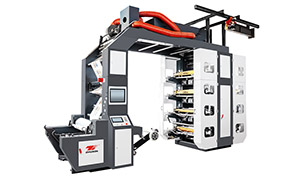
High Speed Flexo Printing Machine - Stack Flexo Flexo Printing Machine
Closed-loop register control is the most critical automation function. It uses optical sensors to read register marks after each color and compares the detected position against the setpoint. The error signal is processed by a high-bandwidth controller (often using a combination of feedforward and predictive algorithms) that adjusts the phase of the plate cylinder via its servo motor. The correction is applied within milliseconds to compensate for substrate stretch, mechanical play, and thermal expansion. Modern systems achieve register accuracy of ±0.02 mm even at 500 m/min, with a response time of less than 50 ms.
Color density control is another closed-loop loop: a spectrophotometer measures the density and color values of a control patch after drying/curing. The controller adjusts the anilox roller speed (or the chamber pressure) to vary ink film thickness, or it can change the temperature to alter viscosity. Some systems use a "preset" based on a model of the ink's behavior, then refine it with feedback. This ensures that the color stays within ΔE 1.0 across the run.
Predictive maintenance is enabled by an array of sensors: vibration accelerometers on bearings, temperature sensors on motor windings, pressure sensors on hydraulic systems, and current signature analysis on servo drives. These data are fed into machine learning algorithms that detect anomalies and predict failures before they occur. For example, a gradual increase in the harmonic content of the motor current may indicate bearing wear, and the system can schedule maintenance during the next job changeover, avoiding unplanned downtime. This approach has been shown to reduce maintenance costs by 20-30% and increase uptime by 5-10%.
Artificial intelligence is increasingly applied to process optimization. Reinforcement learning agents can explore different combinations of impression pressure, anilox-to-plate nip, and dryer temperature to find the optimal setpoints for a given substrate-ink combination, minimizing waste and maximizing speed. These agents are trained offline using simulation models, then deployed as advisory systems that suggest settings to the operator. Some presses are equipped with autonomous setup routines where the press runs a short test pattern, the camera analyzes the print, and the control system automatically adjusts all parameters to achieve target quality – a process known as "closed-loop setup" that can reduce makeready waste from 100 meters to 10 meters.
Communication networks: The entire automation system relies on deterministic real-time fieldbuses (like EtherCAT, POWERLINK) with cycle times in the sub-millisecond range. This ensures that all motors are synchronized within microseconds, essential for print registration. Safety functions (emergency stops, light curtains, safety interlocks) are integrated into the same network using a safety protocol (e.g., FSoE), meeting SIL3/PL e standards.
The human aspect: Despite high automation, the operator's role has evolved to a supervisor who monitors the automation, handles exceptions (e.g., substrate splices, blockages), and performs preventive maintenance. The HMI provides intuitive dashboards with clear alarms and process trend indicators. The data collected from the press is used for continuous improvement – by analyzing correlations between process parameters and final quality, manufacturers can refine their standard operating procedures. The future of
flexo printer automation is heading towards "lights-out" operation, where the press runs fully autonomously for entire shifts, with only occasional human intervention for roll changes and routine checks. This is already a reality in some high-volume plants, showcasing the maturity of flexo control technology.