Flexo Print Quality: Density and Dot Gain – Measurement, Analysis, and Control Strategies
Print quality in flexo is largely defined by two measurable attributes: optical density (color strength) and dot gain (the enlargement of printed dots relative to the plate). Both are influenced by ink film thickness, impression pressure, and substrate properties. This article provides a systematic approach to measuring, analyzing, and controlling these parameters.
Optical density is measured with a densitometer; it is the logarithm of the ratio of incident to reflected (or transmitted) light. For a solid area, the density should be within a target range (e.g., 1.3-1.8 for process colors). Density variations are caused by changes in ink film thickness (anilox volume, transfer efficiency) and ink formulation (pigment concentration). Inline densitometers provide real-time feedback, and the control system adjusts the anilox-to-plate pressure or the ink pump speed to maintain density.
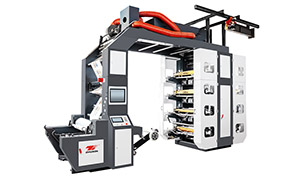
High Speed Flexo Printing Machine - Stack Flexo Flexo Printing Machine
Dot gain is the difference between the dot area on the plate and on the print; expressed as percentage increase. For a 50% tone, typical flexo dot gain is 15-25%, depending on the anilox, plate, and impression. Dot gain affects tone reproduction; excessive gain causes loss of shadow detail and color shifts. It is measured using a test form with tints (e.g., 10-90%) and a densitometer; the Murray-Davies formula converts density to dot area. Dot gain analysis reveals the press's characteristic curve, which can be corrected by adjusting the plate's dot size (compensation curve) in the prepress.
Root causes of density variation: anilox cell wear (reduces volume), doctor blade wear (increases ink film), ink viscosity changes, and impression pressure fluctuations. For dot gain, the main causes are impression pressure (higher pressure increases gain), anilox cell volume (larger volume increases gain), plate durometer (softer plates gain more), and substrate roughness (rougher surfaces cause more dot gain due to physical spreading).
Control strategies: For density, closed-loop viscosity control and automatic impression adjustment are essential. For dot gain, the plate's dot compensation is applied: the plate is designed with smaller dots to compensate for the predicted gain. This requires a calibration curve for each substrate and anilox combination. The press's control system can store multiple curves and recall them based on the job.
Tools for analysis: A quality control strip printed at the edge of the web contains patches for density and dot gain. This strip is scanned by the inline spectrophotometer. The data is plotted on a control chart; if the dot gain shifts beyond the control limits, the operator is alerted. Advanced systems use multivariate analysis to correlate dot gain changes with specific press parameters (e.g., speed, temperature), enabling precise adjustments.
Interaction with other parameters: Density and dot gain are interdependent; increasing impression to boost density also increases dot gain. The optimal setting is a compromise. The target is to achieve the required density with minimal dot gain; this is done by selecting the appropriate anilox volume and plate hardness, and setting the impression to the lower end of the acceptable range.
By rigorously controlling density and dot gain, flexo printing achieves predictable, consistent quality that meets or exceeds customer specifications, reducing rework and increasing customer satisfaction.